Summary
- MidEast to Asia VLCC rate hit 2-week high on Monday
- China to charge about $15 million in port fees for US-linked VLCC, trader says
- Ships divert to Zhoushan after US sanctions Rizhao port
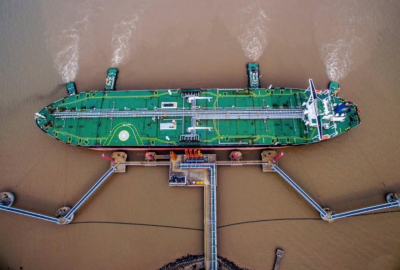
(Reuters) – Supertanker freight rates surged this week and are set to stay elevated on U.S.-China tit-for-tat hikes in port fees and concerns about the fallout from U.S. sanctions on a major Chinese crude oil terminal.
Chinese retaliatory port fees announced on Friday would add more than $7 a barrel in shipping costs for a Very Large Crude Carrier linked to the U.S., traders estimated. That would be equivalent to a charge of around $15 million – a sum that would put anybody off chartering ships related to the United States.
Get the Latest US Focused Energy News Delivered to You! It’s FREE:
The VLCC spot rate for the Middle East to China route, known as TD3C , hit a two-week high on Monday of W98 on the Worldscale industry measure used to calculate freight rates, according to LSEG data.
On Wednesday, that had slipped slightly to W95 or the equivalent to a lump sum payment of about $6.2 million, shipbrokers said. But it remains much higher than levels of around W70 a week ago.
CHINESE RETALIATION
The rally in rates was triggered by China saying it would impose its own additional port fees on U.S.-linked vessels, a retaliatory measure against U.S. port fee hikes for Chinese ships announced earlier in the year.
Beijing later said that Chinese-built ships would be exempted. Both sets of levies went into effect on Tuesday.
“The rates are indeed up as it reduces the pool of tankers available that meets the criteria to avoid incurring the hefty loadport fees,” said June Goh, a senior oil market analyst at Sparta Commodities.
“However, since China is now exempting China-made vessels from the ruling, there is a bit of reprieve there,” she added.
One shipbroker, who declined to be named due to company policy, said owners of non-U.S. tankers might ask for a premium which could push freight rates higher.
Clarksons Research has estimated that about 12% of the world’s crude tanker fleet would be subjected to China’s port fees on vessels related to the U.S. after China exempted Chinese-built ships.
RIZHAO PORT SANCTIONS
Friday’s imposition of U.S. sanctions on Shandong’s Rizhao oil terminal has forced trading firms to divert more ships to Zhoushan, also on China’s east coast, potentially creating congestion at the transfer hub linked to major Sinopec refineries and mega refiner Rongsheng Petrochemical, traders said.
“The sanctioning of the Rizhao Oil Terminal contributed to freight volatility in the East,” said Brendan Bos, a market analyst at Gibson Shipbrokers.
“It has already led to greater trade inefficiencies as several VLCCs have diverted, though it is likely that new outlets for the crude will be found and that the medium-term impact will be muted,” Bos said.
The Rizhao Shihua Crude Oil Terminal, half-owned by a Sinopec logistics unit, was among entities listed by the U.S. Treasury in a round of sanctions that also includes ships transporting Iranian crude oil and liquefied petroleum gas.
The shipbroker who declined to identified said the number of VLCCs needed to carry cargoes from the Middle East, Europe, Africa and the U.S. to Asia is likely to be higher in October than September, which will underpin freight rates.
Current TD3C rates are not too far away from more-than-two-year highs hit in September at around W108 when tanker supply tightened on a rise in exports from the Middle East and more arbitrage supplies to Asia.
Reporting by Florence Tan and Jeslyn Lerh; Additional reporting by Sam Li in Beijing; Editing by Edwina Gibbs and Louise Heavens
Share This:
More News Articles