By
LONDON, March 11 (Reuters) – U.S. stock market indexes have weathered this month’s oil shock well so far because investors expect only a glancing overall GDP hit from higher energy costs. But that resilience masks a potentially toxic shift of income from households to “Big Energy” – and packs big risks in an election year.
With uncertainty still rife about the extent and length of the Iran war, sharp and volatile spikes in energy prices have left oil and natural gas costs looking structurally higher over the coming year. Worries about food prices are creeping in too, as fertilizer shipments are also being snagged in the Middle East Gulf region.
Get the Latest US Focused Energy News Delivered to You! It’s FREE:
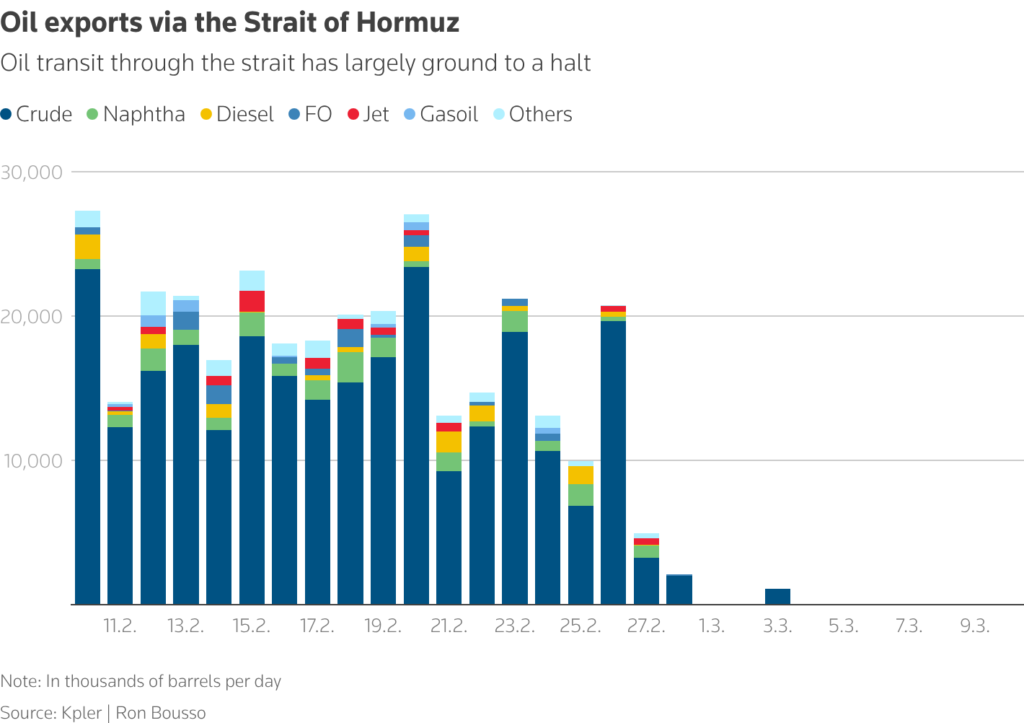
Oil exports via the Strait of Hormuz
As inflation is spurred once again, the chances of U.S. interest rate cuts this year have been reduced or pushed back.

Chart shows brent price
None of that sounds like good news for the U.S. economy or consumers overall, at least not until you make calculations about America’s new-found position as a net exporter of energy.
For the producers and exporters of all that domestic U.S. oil and natural gas, this is a big windfall. And unlike their competitors in the Middle East or elsewhere, there’s no security threat or blockage in getting their product to market.

An area chart with the title ‘US energy exports’
Carlyle strategist Jason Thomas points out that the U.S. ran an annualized energy trade surplus of nearly $100 billion in the last 12 months and the surge in oil and gas prices will only increase that substantially.
“Higher gasoline prices still could be conceived of as a ‘tax’ on U.S. consumers, but that’s offset today by an increase in domestic revenues that didn’t exist when the energy price shock of 2007-08 shaved over 1% from U.S. GDP,” he wrote, pointing to the period in which oil and gas prices roughly trebled in 18 months.

Carlyle chart on US energy balance in surplus
But with the U.S. now a net exporter of petroleum products for the first time since the 1950s, assumptions of a 2007–08‑style GDP hit – one that could halve U.S. growth on a comparable oil price surge today – now look wide of the mark.

US petroleum trade balance in surplus
GLANCING BLOW
Apollo Global (APO.N) Chief Economist Torsten Slok’s “ready reckoner” – a quick rule‑of‑thumb guide built from Federal Reserve models – shows that even if crude oil stays above $100 a barrel through 2027, the shock’s impact fades over time and leaves only minor aggregate impacts on the macro economy.
While the net impact on headline inflation could be as high as 0.7 percentage point, the effect on real GDP, unemployment and core inflation is just 0.1 point, he showed.
“The U.S. is a net oil exporter and energy efficiency has improved significantly over the years – meaning the economy burns less oil per unit of GDP compared to historical levels (and) helps dampen the overall negative impact of price spikes.”
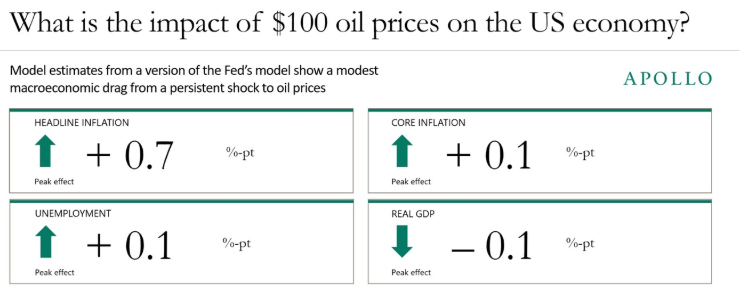
Apollo estimates on oil rise impact
Not everyone thinks it would be such plain sailing if the shock persists.
Morgan Stanley estimates that if a 25% oil price jump driven by a supply shock lasts four quarters, real GDP would be about 1.5% lower, with most of the damage occurring in the first three.

Morgan Stanley chart on impact of oil spike on inflation
But the issue is that GDP can hold quite well even though everyone seems to acknowledge that higher energy prices, and inflation more broadly, act as a tax on households.
ELECTION YEAR PRESSURES
If the impact of a sustained oil shock were to have the minimal GDP impacts some suggest, then all that’s really happening is that money is being redistributed to domestic energy companies from already stretched households.
Government could step in to subsidizeand cushion households, but that simply shifts the burden onto an already stretched Treasury – and ultimately back onto the public.
The political toxicity of high U.S. headline inflation – even if the Fed focuses on core rates that strip out energy and food – has been well documented since the COVID-19 pandemic.
In a midterm election year, sensitivities in Washington will be even higher, which helps explain why Wall Street seems convinced the conflict will be limited and that it should buy the dip as GDP sails on regardless.
But a raid on household wallets that just ends up in domestic oil and gas firms’ coffers might not go down well at the polls, especially if voters believe the oil surge was triggered by U.S. military action in the first place.

Stacked bar chart about gas price predictions
The opinions expressed here are those of the author, a columnist for Reuters.
by Mike Dolan; Editing by Marguerita Choy
Share This:
More News Articles