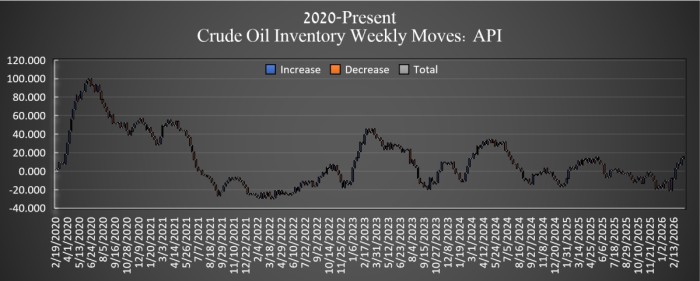
The American Petroleum Institute (API) estimated that crude oil inventories in the United States rose by 2.3 million barrels in the week ending March 20. In the week prior, US crude oil inventories rose by 6.556 million barrels. Analysts had expected a draw of 1.3 million barrels in the current reporting period.
Inventories in the US Strategic Petroleum Reserve (SPR) have stayed at 415.4 million barrels for multiple weeks in a row as of the week ending March 20. This is 310.1 million barrels shy of maximum capacity.
US production fell for the fourth week in a row, this time by 10,000 bpd, sinking to an average of 13.668 million bpd for week ending March 13, according to the latest EIA data. This is 95,000 bpd more than this same time last year.
At 4:14 pm ET, Brent crude was trading up on the day at $103.70 (+3.79%). Brent is up roughly $0.40 per barrel up from this time last week as tanker traffic through the Strait of Hormuz remains largely at a standstill, with oil production losses in Iraq, UAE, and Saudi Arabia. WTI was also trading up on the day, by $3.81 per barrel (+4.32%) at $91.94, although down week over week.
Gasoline inventories rose this week by 500,000 barrels in the week ending March 20. In the week prior, gasoline inventories fell by 4.6 million barrels. As of last week, gasoline inventories were 3% above the five-year average for this time of year, according to the latest EIA data.
Distillate inventories rose by 1.4 million barrels, after decreasing by 1.4 million barrels in the week prior. Distillate inventories were 3% below the five-year average as of the week ending March 13, the latest EIA data shows.
Cushing inventory—the inventory kept at the delivery hub for the WTI Crude futures contract—added 4 million barrels.
By Julianne Geiger for Oilprice.com
More Top Reads From Oilprice.com
- Indian Refiners Cautious Over Iranian Oil Despite U.S. Waivers
- UAE: Weaponizing Hormuz is Economic Terrorism Against the World
- Outage in Australia Adds to Global LNG Crunch