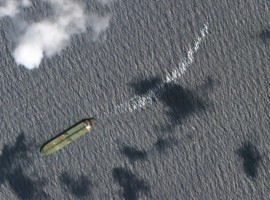
Iran has seized a tanker that appears to have been carrying its own oil, highlighting just how tangled its export system has become under sanctions and blockade.
State media said Iranian forces detained the vessel, identified as the Ocean Koi, in the Gulf of Oman. The ship had already been sanctioned by the United States earlier this year as part of Iran’s shadow fleet, the network used to move crude outside official channels.
Iran’s explanation didn’t add much clarity. Officials said the tanker was carrying Iranian oil but had tried to exploit regional conditions. No details on what that actually means.
The U.S. naval blockade has sharply reduced Iran’s ability to export crude. Tankers are being forced to turn back, and a growing number of cargoes are sitting at sea. Some of that oil is effectively in limbo, caught between sanctions, enforcement, and a shrinking number of buyers willing to take the risk.
Many of Iran’s barrels don’t move neatly from point A to point B. Instead, they move through intermediaries, reflagged vessels, and opaque ownership structures. In fact, a single cargo can change hands on paper multiple times before it ever reaches a buyer.
Seizing a tanker tied to that system suggests that Iran is tightening control over its own flows as pressure mounts. If exports are restricted and storage is rapidly filling up, each cargo becomes more important. Oil slipping through the wrong channel could become a big problem.
The market largely ignored it. Traders are already assuming disruption. The bigger issue is that Iran’s ability to move oil is still restricted, and that constraint is already baked into the market.
By Julianne Geiger for Oilprice.com
More Top Reads From Oilprice.com
- First Oil Tanker Reaches South Korea Through Hormuz Since War Began
- India’s Inflation Accelerates as High Energy Prices Start to Bite
- Iran Seizes Sanctioned Oil Tanker in Gulf of Oman