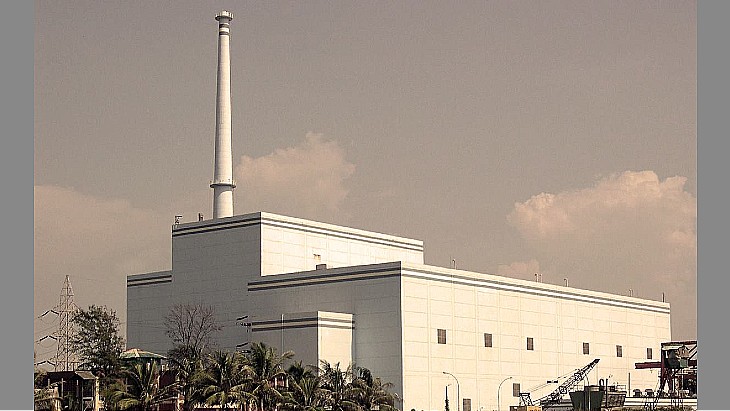
The Atomic Energy Regulatory Board (AERB) has announced that it approved the restart and continued operation of unit 2 at the Tarapur power plant in Maharashtra on 7 May following the completion of the refurbishment undertaken by Nuclear Power Corporation of India Limited (NPCIL).
The refurbishment included the complete replacement of reactor coolant recirculation piping with forged piping and fittings made of advanced corrosion-resistant stainless steel, the regulator said, as well as safety upgrades including the commissioning of the reactor containment filtered venting system and the alternate cooling water system. During the extended outage, inspections of critical reactor components such as reactor pressure vessel welds were carried out as part of the assessment of the unit’s ageing status and residual operating life. “The evaluations have shown that the reactor can continue safe operation with the normal maintenance and surveillance programme,” the AERB said.
The regulator has now given permission for the unit – known as TAPS (for Tarapur Atomic Power Station) unit 2 – to restart and operate for a further 10 years. The regulator said it will continue to maintain its regulatory oversight and monitor the safety performance of both units at the plant. It issued a permit for TAPS unit 1 to restart after its refurbishment last December: that unit is now operating at its rated power of 160 MWe, the AERB said.
Tarapur 1 is one of two BWR units commissioned at the site in Maharashtra in 1969 as India’s first commercial nuclear power plant. Built by GE on a turnkey contract, the units were originally rated at 200 MWe but were subsequently downrated to 160 MWe (gross). They underwent six months’ refurbishment in 2005-06, but have both been offline since 2020 for major refurbishment work.
Looking to new build
NTPC’s completion of its first feasibility study for a nuclear project has been widely reported in the Indian press. The company – which recently signed a non-binding memorandum of understanding with France’s EDF to explore cooperation in developing new nuclear power projects in India – is set to submit the first feasibility study for a nuclear project for approval by the Department of Atomic Energy (DAE), which would pave the way for NTPC to begin work on its first standalone nuclear project in India.
The company is also in the process of conducting feasibility studies in two more states, and has received a go-ahead from the government of Bihar to conduct a feasibility study for a nuclear project in Banka district, the Economic Times reported, quoting a source who said NTPC “is looking to set up at least two units of 700 MW each in the states being explored for nuclear projects”.
NTPC is a Public Sector Undertaking under India’s Ministry of Power. It currently operates more than 89 GW of installed capacity, with another 32 GW under construction, with a target to reach 149 GW of total capacity by 2032, including 60 GW from renewable energy sources, with a balanced mix of thermal, hydro, solar, and wind power plants, ensuring supply of reliable, affordable, and sustainable electricity to the country.
Restrictions under Indian law have in the past presented a barrier to the participation of private companies like NTPC in nuclear power projects, although NTPC is now part of the Anushakti Vidhyut Nigam Ltd (Ashvini) joint venture with NPCIL which is developing two Indian-designed 700 MWe pressurised heavy water reactors, Mahi Banswara Rajasthan Atomic Nuclear Power Project units 1 and 2, for which excavation works began in late March.
The Sustainable Harnessing and Advancement of Nuclear Energy for Transforming India (SHANTI) Act 2025 – enacted at the end of last year – opens up India’s nuclear sector to participation from private companies, including in plant operations, power generation, equipment manufacturing, and selected activities such as nuclear fuel fabrication.
Included among the final rules related to that legislation may be a change to the size of planned exclusion zones around nuclear power plants, Reuters has reported. India currently requires a minimum buffer of about 1 km (0.62 miles) around reactors where no habitation or economic activity is allowed, but unnamed industry officials told the news agency that the DAE and the AERB have approved an in-principle plan to reduce this to 500 metres for small reactors and 700 metres for large reactors, saying this reflects safer reactor technologies, and is in line with global norms followed by countries like the USA and France.
The revised buffer zones would cut the land needs by half for large reactors and by nearly two-thirds for small units, potentially allowing two to three times more capacity on the sites, Reuters said, citing an internal presentation it has reviewed.