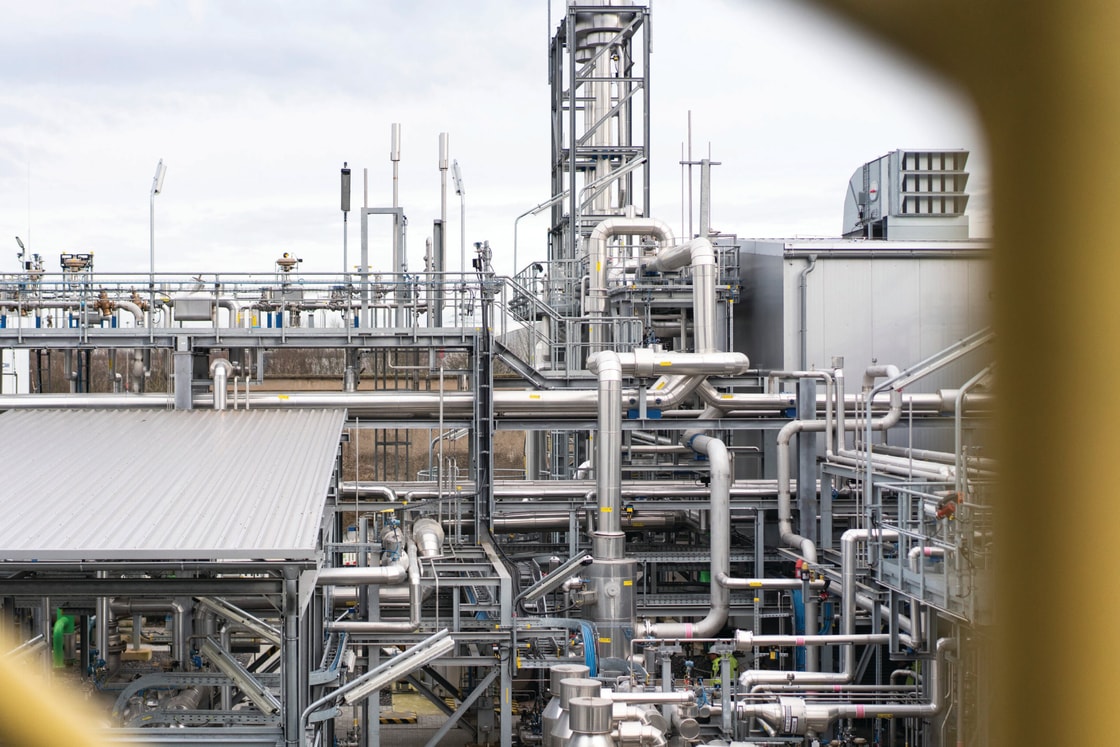
There are decisions to make when it comes to industrial design and fire and gas mapping. Murray Farmer, Head of Business Development at Dräger Middle East, North Africa, looks at the variables in play
Gas and flame detection systems in industrial plants have a key function: to ensure maximum safety and mitigate the risk of further escalation if and when gases escape or fire starts.
At the same time, companies need to operate economically and efficiently. To pull this off, a planning and design phase is key to creating what is needed.
How you deliver this is something that is changing. Scenario-based models are increasingly emerging alongside the traditional geographical approach in the context of fire and gas mapping. While these methods are often promoted as a way to reduce over-engineering and cost, the question is not so much which method is superior but how they are applied.
Part of the challenge is to ensure that industrial layouts are optimal, since gas mapping aims to ensure that all detection devices are positioned effectively.
From practice to theory: scenario mapping
The scenario-based approach to mapping is risk-based, looking at gas clouds and equipment. These scenarios consider realistic gas dispersion behaviour, including both the dense core and the surrounding dilute cloud. Using this approach, specific and credible scenarios are established based on known hazards, process conditions and potential escalation pathways.
Beyond this, the scenarios are then linked to clearly defined safety and performance targets, such as detecting a gas cloud before it reaches a critical size or concentration – or detecting a fire at a defined size of energy-release rate within a given timeframe.
In contrast to probabilistic modelling, which may generate a wide variation of possible outcomes depending on chosen assumptions, this approach supports a more defensible system and consistent design. It means that detection coverage and detector numbers are neither excessive nor insufficient, but aligned with the actual risk.
Probabilistic scenario mapping is the other approach. Here, a theoretical take that aims to predict the probability and consequences of a specific event. It generates a quantitative risk assessment (QRA). Unlike geographical mapping, the approach does not primarily analyse the location, but simulates the sequence of a specific event – such as a leak, release, spread or ignition of gases or liquids – and its knock-on effects.
One method for predicting events within the framework of scenario mapping is computational fluid dynamics (CFD). This aims to predict the behaviour of certain substances based on mathematical calculations, such as the way in which a specific gas will disperse under certain conditions in a specific environment. However, wind speed or direction, congestion or confinement and changing process conditions can make outcomes highly dependent on assumptions rather than being locked into repeatable engineering logic.
Choosing the way ahead
How does one choose the best way forward? Context matters a lot.
In open environments, such as outdoor applications, where the factors influencing gas dispersion are virtually endless, the number of scenarios that must be considered is also infinite. This is where the limitations of probabilistic CFD modelling become apparent, as there are no clear guidelines on how many and which scenarios should be modelled. This can lead to two design engineers arriving at completely different results, both of which are compliant with regulatory demands.
Moreover, uncertainties on parameters and scenarios can lead to high costs implicated with more complex modelling. Thus, it depends on the responsibility and expertise of the engineer to select the appropriate scenarios.
Remember, though, that geographical and scenario-based approaches are not competing methodologies but rathercomplementary tools.
Their respective value lies in how they are applied within the context of clearly defined safety targets and the objectives. So it is not a question of ‘geographical or scenario-based’, but of the specific area of application.
The starting point is therefore always a structured risk management-based engineering approach: identifying sources of danger, defining the potential for escalation, defining the objectives of the safety measures, knowing and understanding the available mitigation measures, selecting the right detector technology, and, finally, modelling and verifying the selected design.
In both approaches, modern software tools play a critical role in the process – not as standalone solutions but as part of a wider engineering workflow. They support scenario evaluation, detector placement validation, and demonstrate that defined performance targets are achieved. At the same time, the output is only as reliable as the assumptions and inputs defined by the engineer.
Design and the geographic approach
The view remains widespread in the industry that traditional geographical mapping leads to more conservative and thus, in cases of doubt, to less effective safety designs, more sensors and higher costs.
But this view is short-sighted. In practice, the risk of oversizing only arises if traditional mapping is carried out too simplistically.
When executed as a performance-based exercise, geographical mapping provides a consistent and reliable baseline – although in some cases it can result in more conservative designs compared to targeted, scenario-based approaches, it does not increase conservatism but removes inefficiency. When carried out expertly, the customer benefits from a minimum number of devices wherever this is appropriate from a safety perspective. They also benefit from reduced cabling and installation costs, less installation complexity – which usually goes hand in hand with time savings – and a lower maintenance burden throughout the system’s entire lifecycle.
The human factor
A robust fire and gas review does not begin with selecting a methodology: it begins with understanding and addressing the risks and required safety objectives effectively.
This, as explored, requires a structured engineering approach: it comes to to identifying the hazards, establishing a risk register, defining escalation scenarios and setting clear safety and performance targets. Once these are defined, an appropriate detection philosophy can then be developed – and the right tools selected.
The safety targets will vary. They may include detection response time or the ability to identify a hazardous gas cloud before it reaches a critical size where, if ignited, it can cause explosion overpressures which can cause structural damage and further escalation.
This, in turn, requires a profound understanding of detector technologies and how they operate – their strengths, weaknesses, response characteristics, environmental sensitivities and limitations.
And it is this expertise that determines the choice between excellent consultancy and standard procedures.
Once the right choices are made, it is these that will ensure that customers achieve not only maximum safety but at the bestpossible price.