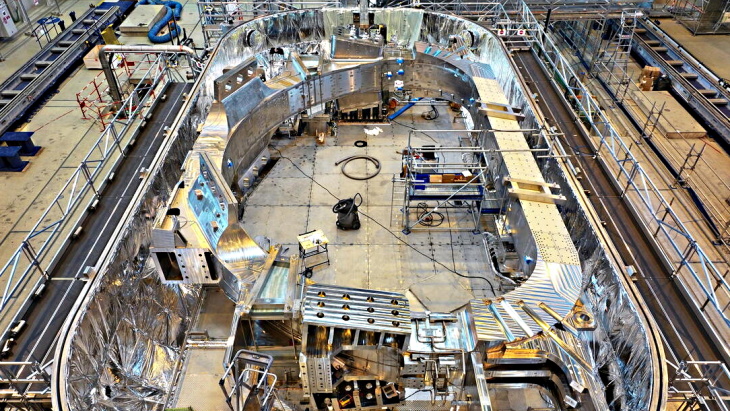
The ITER magnet cold testing programme was launched in 2023 as part of ITER’s revised approach to assembly and commissioning. The facility is located in a building at Cadarache, France, previously used by the European Domestic Agency to manufacture ITER’s four largest poloidal field coils, and it takes advantage of the building’s scale, lift equipment, and proximity to the cryoplant. The facility will allow ITER to test selected superconducting magnets at their operating temperature of 4 Kelvin and up to full current before installation in the fusion machine.
ITER’s magnetic system consists of toroidal and poloidal magnetic field coils, correction coils, and the central solenoid.
The first magnet coil to undergo testing in the Magnet Cold Test Facility is a 330-tonne ITER toroidal field coil, wound from niobium-tin superconductor. Additional toroidal field coils from different manufacturers will follow, along with one ring-shaped poloidal field coil – ITER’s smallest, PF1.
The first ITER coil was cooled to 4 Kelvin over a 12-day period in the 800-cubic-metre cryostat of the ITER magnet test facility. The milestone was announced on 21 May. Members of the ITER Council Management Advisory Committee attending a meeting on site joined the technical teams in the ITER control room for a small ceremony marking the achievement.
The conductor now has transitioned to its superconducting state, and high-current testing is expected to begin shortly, ITER said. Each test campaign is expected to take four to six months per coil.
“Although no external test can fully reproduce operating conditions inside the ITER machine, tests in the magnet cold test facility will provide essential information on magnet behaviour, cryogenic performance, electrical interfaces, instrumentation, and the critical joints that connect the layers of wound superconductor inside of the magnet coils, and strengthen ITER’s risk mitigation and readiness,” ITER said.
The main objectives of the tests are to validate high-voltage ground insulation at different temperatures, demonstrate critical quench detection capabilities, and verify coil performance at nominal current (68 kA for the toroidal field coils and 48 kA for PF1). The programme will also test instrumentation chains, control logic systems, and key magnet protection functions. The central solenoid modules were cold-tested prior to shipment.
“ITER as a first-of-a-kind project requires ingenuity as well as discipline,” said ITER Director-General Pietro Barabaschi. “By repurposing existing infrastructure, using the capabilities of our cryoplant, and mobilising a multidisciplinary team, we have created a practical way to reduce risk before integrated commissioning. This is important for ITER as well as an example of how ITER can support the wider fusion ecosystem by creating knowledge, infrastructure, and operational experience that others can use.”
Following the testing of multiple ITER magnet coils, the magnet cold test facility will be made available to other fusion stakeholders as part of the ITER Organization’s knowledge-sharing and engagement initiatives with the private fusion sector.
ITER is a major international project to build a tokamak fusion device designed to prove the feasibility of fusion as a large-scale and carbon-free source of energy. The goal of ITER is to operate at 500 MW (for at least 400 seconds continuously) with 50 MW of plasma heating power input. It appears that an additional 300 MWe of electricity input may be required in operation. No electricity will be generated at ITER.
Thirty-five nations are collaborating to build ITER – the European Union is contributing almost half of the cost of its construction, while the other six members (China, India, Japan, South Korea, Russia and the USA) are contributing equally to the rest. Construction began in 2010 and the original 2018 first plasma target date was put back to 2025 by the ITER council in 2016. However, in June 2024, a revamped project plan was announced which aims for “a scientifically and technically robust initial phase of operations, including deuterium-deuterium fusion operation in 2035 followed by full magnetic energy and plasma current operation”.