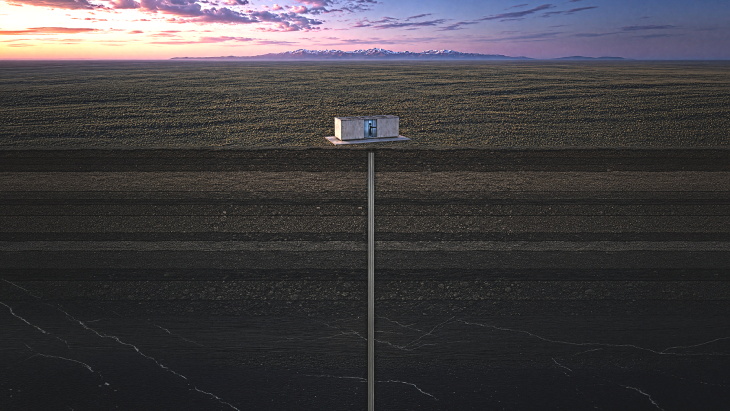
California-based Deep Fission’s Gravity reactor is a small modular reactor (SMR) designed to be placed underground in an optimised borehole one mile (1.6 km) deep. Using traditional pressurised water reactor technology and low-enriched uranium (LEU) fuel, each reactor will generate 15 MWe, the company says, while its small footprint and dense power output means it will need a fraction of the land needed for traditional surface nuclear: ten reactors on the same site would deliver 150 MWe, or 100 reactors would produce 1.5 GWe. The passive shielding and natural containment offered by the surrounding geology, and the combination of mature technologies from the nuclear, oil and gas, and geothermal industries, while using off-the-shelf parts and readily available LEU fuel, aims to improve safety and security and enable a faster, more cost-effective path to deployment.
Deep Fission broke ground in December at the Great Plains Industrial Park in Parsons, Kansas, for its pilot project and plans to build a full-scale commercial plant there following the test reactor demonstration. In August last year, Deep Fission was one of 10 companies selected by the US Department of Energy to receive support under its Nuclear Reactor Pilot Program, which aims to see at least three designs achieve criticality by 4 July this year.
Day & Zimmermann (D&Z) and Deep Fission have now announced a partnership in the construction of Deep Fission’s Gravity reactor.
“Deep Fission’s advanced reactor technology, combined with Day & Zimmermann’s quality programme and nuclear expertise, will bring first-of-a-kind nuclear construction to reality,” said D&Z Chief Nuclear Officer Ross McConnell. “For more than 40 years, the power industry has trusted our operational discipline and process-driven approach to quality, safety, and project execution while reliably and safely navigating the Nuclear Regulatory Commission’s complex oversight. Our partnership with Deep Fission reflects our continued leadership in advancing nuclear technology, and we’re excited to move this project forward together.”
D&Z said it was “among a select group of companies with not only the qualifications to perform nuclear-code work needed for expanding and modernising the nation’s nuclear energy infrastructure, but also with natural gas plant construction experience … essential for building the non-nuclear, above-ground turbine generator systems of Deep Fission’s Gravity reactor”.
“Partnering with Day & Zimmermann will bring proven nuclear construction expertise and execution discipline to Deep Fission’s deployment,” said Mike Brasel, Chief Operating Officer at Deep Fission. “Their track record supports our aim to deliver a new model for low-carbon, reliable power that is simpler to build, inherently safe, and scalable to meet growing energy demand.”
Deep Fission was founded in 2023 by father-daughter team Elizabeth and Richard Muller, who also co-founded Deep Isolation in 2016 to develop the concept of placing canisters of radioactive waste hundreds of metres underground via a borehole.
3D printing of SMR components
Indiana-based high-temperature small modular reactor developer NX Atomics has announced a partnership with Sciaky – a division of Morphix Metals – to apply Sciaky’s proprietary Electron Beam Additive Manufacturing (EBAM) process to the production of components for NX Atomics’ SMR platform.
Chicago-based Sciaky’s EBAM process produces fully dense, high-quality metal parts in a wide range of alloys, including titanium, tantalum, Inconel, and stainless steel. Sciaky’s EBAM technology is used by leading manufacturers in aerospace, defence, energy, and other industries worldwide.
“This is what bringing nuclear manufacturing into the modern era actually looks like,” said NX Atomics CEO John Warden. “3D printing opens up the potential for us to produce nuclear-qualified parts faster and at lower cost, where appropriate swap them out through life, and meaningfully reduce the unit cost of every small modular reactor we build.”
Sciaky CEO John Criso added: “Sciaky has spent more than eight decades building the metal manufacturing technology that the world’s most demanding industries rely on. Our EBAM process produces parts that fly on commercial aircraft, sail on naval vessels, and orbit the earth. Bringing that capability into America’s clean energy infrastructure with NX Atomics is a natural next step, and we are proud that two Midwestern companies are leading this transition.”