Denison’s Board of Directors made its final investment decision in February, after receiving final federal regulatory approvals for the start of construction from the Canadian Nuclear Safety Commission. Provincial-level approvals were already in place. Earlier in the month, Denison announced it had awarded consulting and engineering company Wood Canada Limited the construction management contract to oversee the building of the mine.
Site preparation and early works construction activities actually began soon after the final investment decision. By mid-May, tree clearing activities across the primary mine site area, installation of construction management facilities, construction of an on-site helipad and civil works for the concrete batch plant pad had already been completed, as well as the start of aggregate production at a nearby quarry. Ongoing civil activities include preparations for a future airstrip. Denison has previously said it expects to commence full-scale construction by the end of the second quarter of this year, in line with its target to achieve first uranium production in mid-2028.
Phoenix – part of the Wheeler River project – is described by Denison as the largest undeveloped uranium project in the infrastructure-rich eastern portion of the Athabasca Basin region, in northern Saskatchewan. The project is host to the high-grade Phoenix and Gryphon uranium deposits, discovered by Denison in 2008 and 2014, respectively.
In-situ recovery (ISR) – also referred to as in-situ leach – is a method of recovering uranium minerals from ore in the ground by dissolving them in situ, using a mining solution injected into the orebody. The solution is then pumped to the surface, where the minerals are recovered from the uranium-bearing solution. More than half of the world’s uranium production is now produced by such methods, which do not generate conventional mine tailings.
Phoenix is the first uranium mine in Canada to use the ISR mining method, and the first large-scale Canadian uranium mining project to be approved for construction in more than 20 years, and represents a “bold step forward for the Canadian uranium mining industry”, Denison said: “This is a nation-building project that showcases the very best of Canadian mining ingenuity, collaboration, and determination.”
Over the past couple of years, Denison has signed several agreements with First Nations representatives as well as with communities which amongst other things acknowledge traditional landowners, involve the Athabasca Communities in environmental oversight, and commit to sharing benefits from the successful operation of Denison’s projects including community investment, business opportunities, employment and training opportunities, and financial compensation.
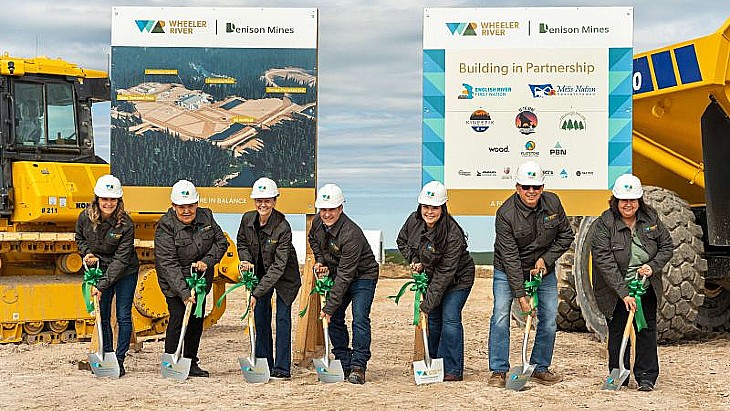
Representatives from English River First Nation, Kineepik Métis Local, Métis Nation-Saskatchewan, and Ya’thi Néné Lands and Resources joined the Denison team for the ground-breaking ceremony.
Speaking to Saskatchewan radio station CKCOM, Councillor Jenny Wolverine for English River First Nation said: “This partnership is developed on the foundation of trust, honesty, definitely humour, understanding and compromise … Because of the support from Denison, we are in a strong position to do great things for our people by our people.”
Representing the Government of Saskatchewan at the ceremony, Minister of Labour Relations and Workplace Safety Ken Cheveldayoff said the development represents new jobs, economic growth, and opportunities for Saskatchewan communities while strengthening the province’s position as a global leader in uranium production.
“What we are celebrating today reflects years of planning, innovation, and commitment. This project will have a significant positive impact on our province during both construction and operations. It will create good jobs and economic opportunities that will benefit Saskatchewan citizens for years and years to come,” he told CKCOM.