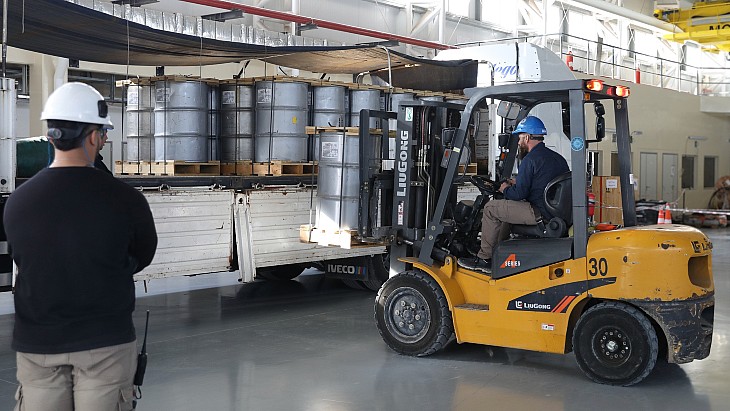
The RA-10 is currently undergoing pre-commissioning testing which is designed to guarantee the safety and efficiency of all its integrated systems.
The receipt of the reactor-grade heavy water, with an isotopic purity of 99.86%, is linked to the final testing of the systems. In the RA-10 reactor, heavy water acts as a moderator and reflector of the neutrons produced in the core.
Argentina’s National Atomic Energy Commission (CNEA) said: “The heavy water will be placed inside the reflector tank, a cylindrical structure two metres in diameter and one metre high, made of Zircaloy-4. The system operating with this fluid is hydraulically isolated from those working with light water to prevent cross-contamination. The reactor also has specific procedures in place to preserve the chemical quality of the heavy water and prevent potential losses during operation.”
The RA-10 multipurpose reactor is a 30 MWt open pool type reactor. The project was approved by the government and officially started by CNEA in June 2010. Argentina’s Nuclear Regulatory Authority granted a construction licence for RA-10 in November 2014. The civil works for the reactor began in 2016. Nuclear technology firm Invap is involved in the design and construction of the reactor facility and related installations, playing the role of main contractor.
The assembly of the RA-10 pool – which will house the core of the reactor – was completed in August 2018. The RA-10 will replace the RA-3 reactor on the same site, a 10 MWt pool-type reactor which began operations in 1967. The RA-10 will also have associated facilities such as the Argentine Neutron Beam Laboratory and the Laboratory for the Study of Irradiated Materials.
Argentina says the facility will guarantee self-sufficiency in radioisotopes for medical use and allow for exports to cover up to 20% of global demand. It will also enable the production of doped silicon for industrial applications as well as facilitating new research in a range of areas and training.
Heavy water – water containing an elevated concentration of molecules with deuterium (“heavy hydrogen”) atoms – is used as a moderator and coolant in Candu reactors, which use unenriched uranium fuel.
The Heavy Water Industrial Plant (Planta Industrial de Agua Pesada (PIAP)) at Neuquén supplied Argentina’s nuclear programme from 1993 but was mothballed in 2017, with the country’s nuclear power plants then relying on imports. With a capacity of 200 tonnes per year, it was the world’s largest such facility, and it remains one of the most advanced. Argentina announced plans to modernise and bring it back into service in 2023, and also In January the CNEA said it would carry out maintenance duties and prepare a bidding process for the work necessary to restart production.
Candu Energy, part of AtkinsRéalis, signed a memorandum of understanding with the CNEA in May 2025 which provided for the restart of the Heavy Water Industrial Plant “along with the long-term acquisition of its heavy water output. It also provides for planning related to the establishment of one or more similar heavy water production facilities in Canada”.