By
56 min ago 2 min read
Hydrogen trucking coalition H2Accelerate has warned the European Commission that weakening its 2030 hydrogen refuelling station targets would undermine investment certainty for zero-emission freight.
The intervention comes as the European Commission assesses whether targets under the Alternative Fuels Infrastructure Regulation (AFIR) remain fit for purpose.
, AFIR requires that hydrogen stations must be deployed in all urban nodes and every 200km along the core TransEuropean Transport Network by 2030. Around 650 stations are expected to be required.
The review will assess whether AFIR’s infrastructure targets remain sufficient and coherent across the bloc as the market for zero-emission vehicles develops, while also examining technical standards, user experience and administrative requirements.
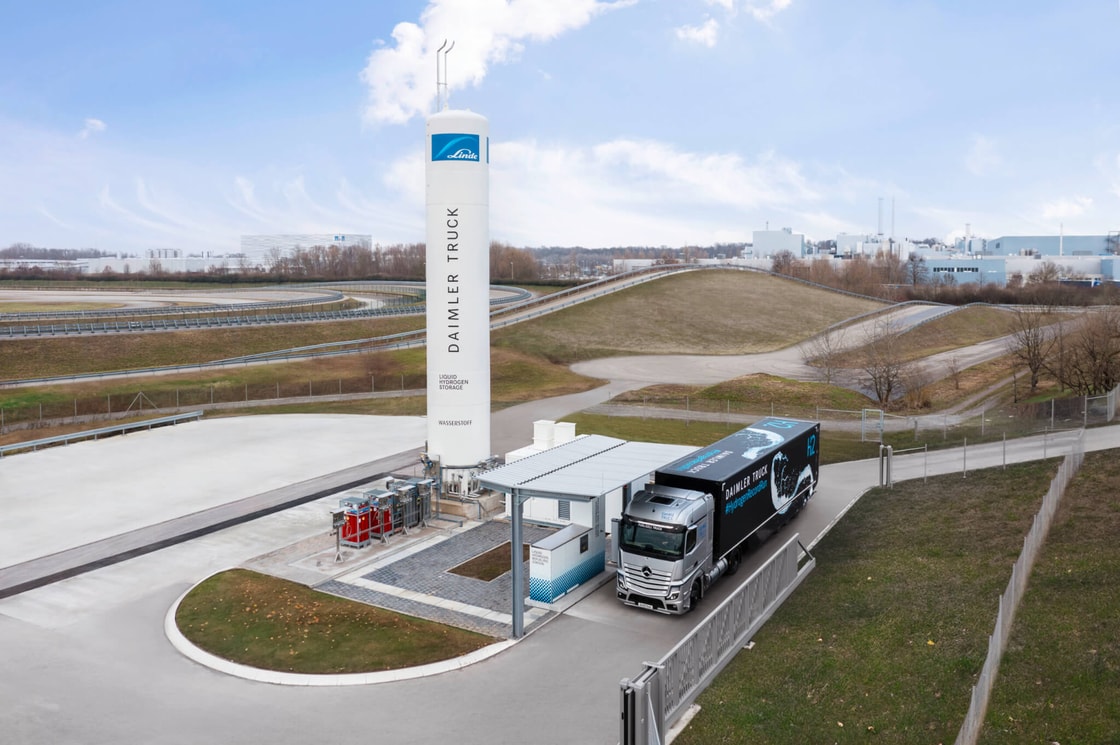
, which comprises truck makers Daimler and Volvo, as well as hydrogen and refuelling players Teal Mobility, TotalEnergies, Hyundai Hydrogen Mobility, and Linde, warned that any reduction risks jeopardising freight decarbonisation.
Hannah Bryson-Jones, spokesperson for the group, called AFIR a “cornerstone policy” for zero-emission trucking.
“Maintaining its [AFIR’s] current ambition reinforces certainty needed to unlock investment in hydrogen refuelling infrastructure, support vehicle deployment, and give fleet operators the confidence to transition to zero-emission trucks,” she said.
H2Accelerate said that despite patchy progress across the bloc, combined truck and refuelling funding schemes in the Netherlands and Germany were helping to deliver AFIR-mandated networks.
Germany’s latest programme to deploy 40 refuelling stations and 400 trucks the €220m ($251m) available budget, with 526 applications.
“The Commission is encouraged to use the review as an opportunity to promote effective member state subsidy schemes to catalyse the deployment of infrastructure in line with requirements under AFIR,” H2Accelerate said.
The review comes as the Commission faces increasing pressure to simplify parts of its climate rulebook while maintaining investment certainty for low-carbon technologies.
While proponents view hydrogen as a complementary technology to battery-electric in heavy-duty applications, deployments has been constrained by the need for vehicles and refuelling infrastructure to be rolled out simultaneously.
Hydrogen also remains the road transport fuel on a per-kilometre basis, according to European Commission data, highlighting the commercial challenges facing widespread truck deployment.