Monday, 10 February 2025
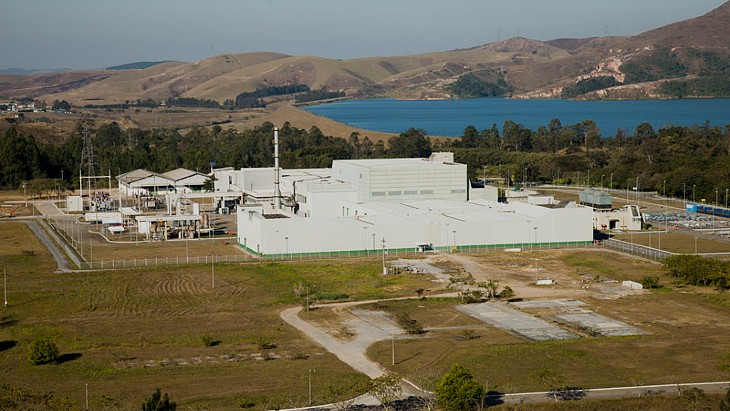
The material was imported in 2016 and has been stored at the Resende Nuclear Fuel Factory. However, Indústrias Nucleares do Brasil (INB) says, “due to its operational unsuitability for fuel manufacturing and the economic unfeasibility of its internal use, the sale will free up space for raw material essential to supply Angra’s nuclear plants, in addition to generating revenue for new investments by the state-owned company”.
Following the decision of the commission (CNEN) the plan is to stage an open competition to achieve the highest price “positioning the state-owned company in new markets and expanding its business opportunities in the global nuclear sector”, according to the state-owned company’s announcement.
Once the potential buyer is confirmed, INB will need to obtain an export licence from the Ministry of Foreign Affairs.
Adauto Seixas, president of INB, said: “This initiative represents a strategic advance for INB, demonstrating our capacity for efficient asset management and taking advantage of commercial opportunities in the international nuclear sector.”
Background
Uranium-235 (U-235) is the main fissile isotope of uranium and occurs at a concentration of about 0.7% in natural uranium. Standard fuel used in today’s operating light water reactors uses low-enriched uranium (LEU), with enrichment levels up to about 4.8% U-235. But higher-enriched – or LEU+ – fuel containing up to 10% U-235 can potentially offer improved nuclear fuel cycle economics for currently operating reactors.
The announcement comes six months after INB announced it was to resume exploration for uranium in the country after a 40-year hiatus. According to World Nuclear Association, exploration in the 1970s and 1980s showed that Brazil has reasonably assured resources of 210,000 tonnes of uranium. However, there has been little investment in exploration since the mid-1980s.
The country’s three main deposits are: Pocos de Caldas in Minas Gerais state, where a uranium mine closed in 1997; Lagoa Real or Caetité in Bahia state, which has been operating since 1999; and Itataia, now called Santa Quitéria, in Ceará state, where the production of uranium as a co-product with phosphate is planned. Uranium has been mined in Brazil since 1982, but the only operating mine is INB’s Lagoa Real/Caetité mine, with a capacity of 340 tU per year. The mine has known resources of 10,000 tU at 0.3%U.
In 2022, Brazil produced 43 tU. All mined uranium is used domestically, after conversion and most enrichment abroad. The country’s uranium requirements are currently about 339 tU per year.
Brazil has two nuclear reactors, Angra 1 and 2, which generate about 3% of its electricity, and a third under construction.