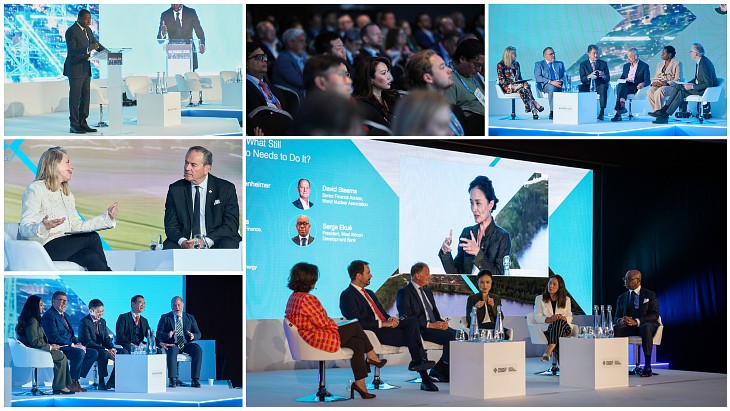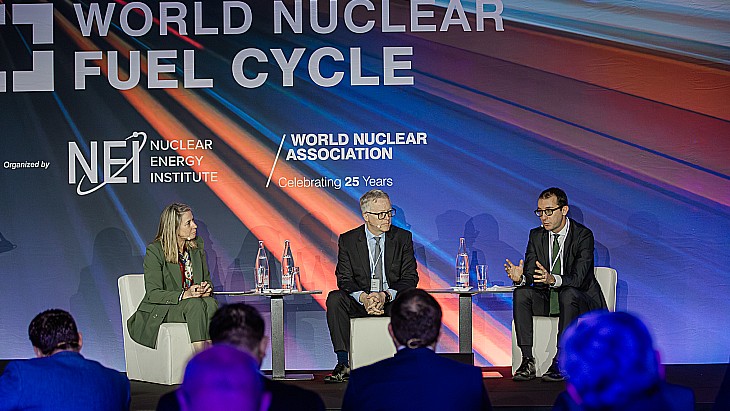
Speakers at the event co-organised by the Nuclear Energy Institute and World Nuclear Association highlighted the challenges and opportunities at a time when geopolitical uncertainty means nuclear energy – underpinned by reliable fuel supplies – is more important than ever.
“Governments all over the world recognise that energy security – and the security of fuel supplies – is more important than ever,” World Nuclear Association Director General Sama Bilbao y León said as she opened the conference together with Nuclear Energy Institute Vice President of Technical & Regulatory Services Jennifer Uhle. But she also called for pragmatism.
“Frankly, momentum is building all over the world, over all markets … but much of that progress is still just ambition,” Bilbao y León said.
“This really is a moment that demands much more than technical progress and technical expertise. We need to continue to ensure that policies support long-term investment, we need to ensure that finance is aligned with clean energy policies, and we need to ensure that regulation is proportional and risk-informed. We need to remember that ambition by itself will not deliver new reactors, will not mine new fuel, and won’t build the supply chains that we need.”
Uhle said this was a moment of profound importance for nuclear energy – and especially in times of geopolitical uncertainty, a stable fuel supply lies at its heart. “Nuclear power doesn’t run just on technology, but also on trust: trust that fuel will be delivered on time and this global network will remain reliable,” she said.
Director General of the nucleareurope trade association, Emmanuel Brutin, and Framatome Senior Senior Executive Vice President Lionel Gaiffe were in agreement that this is a time of change. A shift in sentiment is being seen in European institutions as well as in some countries, Brutin said, calling for support, particularly in terms of policy backing and finance, to foster this.
Now is a “good time to rediscover merits of nuclear energy”, Gaiffe said – and not just in terms of new capacity. Existing reactors provide energy stability, low carbon, and grid stability. Framatome is firstly devoted to providing service to existing reactors. And those reactors need support from a reliable – and sovereign – nuclear fuel supply chain, Gaiffe said.
Incentives
Brutin also stressed the importance of having a sovereign – and also diversified – nuclear fuel supply chain. Brussels is realising that Europe is still dependent on imported fossil energy – and that is expensive, he said. “The solution for Europe is home-grown, clean sources of energy,” he said.
As a net-zero energy source with a value chain that is entirely based in Europe, nuclear is a “huge asset” to the bloc, he said, and several EU-level initiatives are recognising and providing support for this resiliency. The European Investment Bank – a key EU financial institution – has provided significant loans for fuel cycle projects such as the expansion of Orano’s Georges Besse II conversion plant, and having EU financing helps attract other investors. “Even a bit of EU money can go a long way,” he said.
The REPowerEU plan, which was adopted by the European Commission in 2022, aims to rapidly reduce EU dependence on Russian fossil fuels. The legislation defining the policy is still to be finalised.
But while nuclear generation is recognised as environmentally sustainable under the EU Taxonomy Regulation – legislation aimed at channelling finance flows towards sustainable activities – the nuclear fuel cycle itself is not yet part of the Taxonomy. Ensuring the fuel cycle is in the EU Taxonomy would help to attract investors, he said.
Policy support would incentivise fuel cycle capacity, Gaiffe said, but would need to be balanced and “realistic” to ensure capacity grows at a suitable pace to meet demand and avoid a situation of overcapacity.
On-time and on-budget delivery remains the main focus for politicians, Brutin said, but building stakeholder trust in projects is an important factor to drive nuclear fuel cycle growth. “There is this new momentum for nuclear – let’s use it,” he said.