

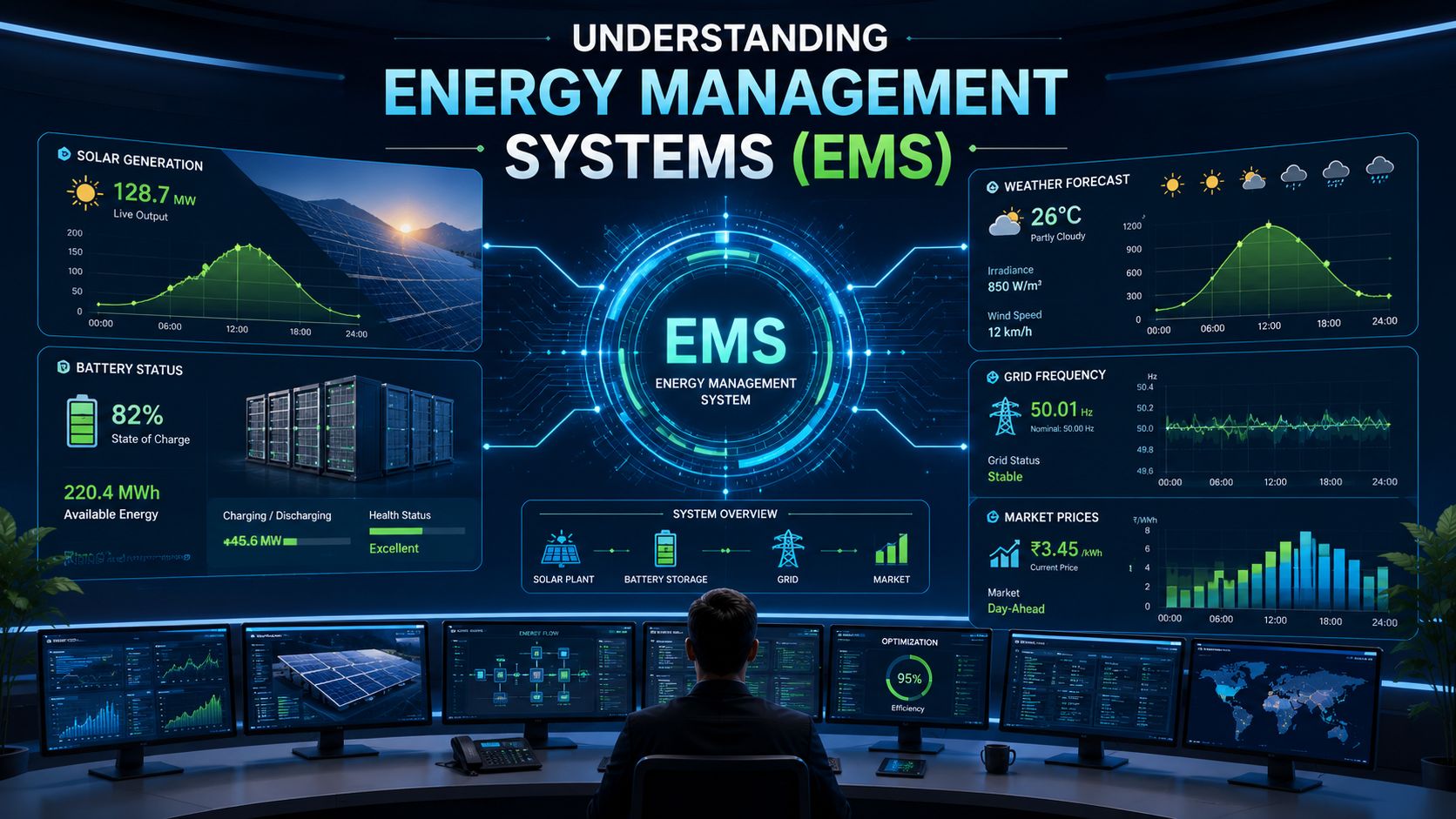
As renewable energy projects become larger and more complex, simply generating electricity is no longer enough. Modern solar plants and Battery Energy Storage Systems (BESS) must continuously respond to changing weather conditions, electricity demand, market prices, and grid requirements. Coordinating these variables requires an intelligent control platform known as the Energy Management System (EMS).
An Energy Management System (EMS) is the central software platform that monitors, controls, and optimizes the operation of renewable energy assets. It analyses real-time data from solar plants, battery storage, weather forecasts, and the electricity grid to determine the most efficient operating strategy. Rather than functioning as a single controller, the EMS serves as the decision-making layer that ensures all connected systems work together efficiently and reliably.
Although these systems work closely together, each serves a distinct purpose. A SCADA (Supervisory Control and Data Acquisition) system collects operational data and enables remote monitoring and control of equipment. A Battery Management System (BMS) focuses specifically on battery safety by monitoring parameters such as voltage, current, temperature, and State of Charge (SoC). The EMS sits above both systems, using their data to optimize overall plant performance, coordinate battery dispatch, and support operational and commercial objectives.
An EMS uses weather forecasting, electricity demand predictions, and real-time market information to determine when batteries should charge, discharge, or remain on standby. By intelligently scheduling energy flows, it maximizes renewable energy utilization, reduces curtailment, supports grid stability, and improves overall plant efficiency. For hybrid projects combining solar, wind, and storage, the EMS ensures that all assets operate as a coordinated system.
As electricity markets become increasingly dynamic, EMS platforms enable renewable plants to participate in energy trading and ancillary service markets. By responding to price signals and grid requirements in real time, operators can improve project revenues while delivering services such as frequency regulation, peak demand support, and load balancing.
The next generation of EMS platforms is incorporating artificial intelligence and machine learning to enhance forecasting accuracy, automate operational decisions, and optimize asset performance. As renewable energy deployment continues to accelerate, the Energy Management System is becoming the digital brain that enables cleaner, smarter, and more flexible power systems.
Subscribe to get the latest posts sent to your email.










)
