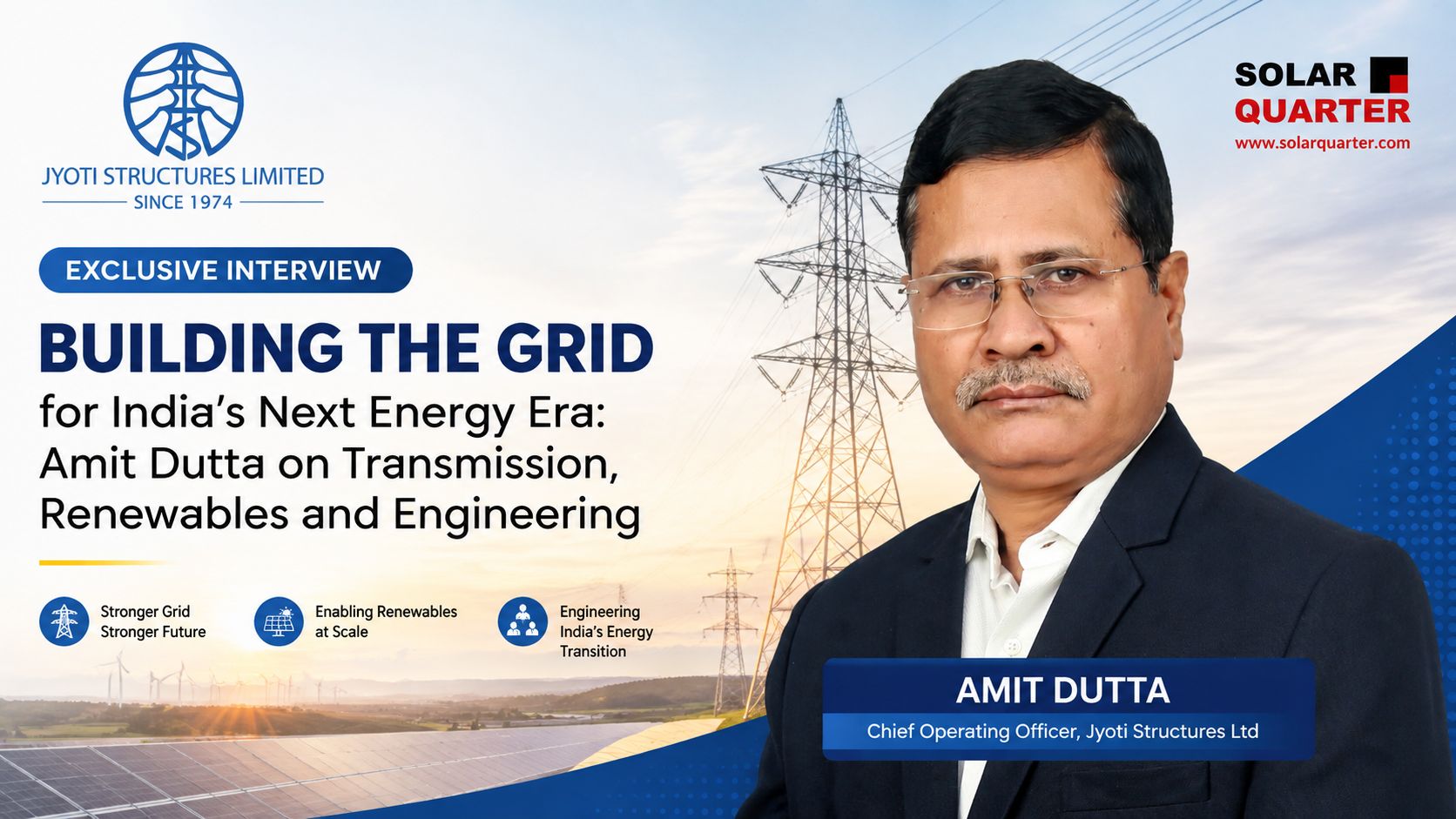
India’s power transmission system has evolved from fragmented regional networks into one of the world’s largest interconnected grids, supporting rapid generation growth and an increasingly renewable-led energy mix. As the country prepares for the next phase of grid expansion, transmission infrastructure, higher-voltage corridors, engineering capabilities and project execution will play an increasingly critical role. In this interview, Amit Dutta, Chief Operating Officer, Jyoti Structures Ltd, draws on 36 years of experience across high- and extra-high-voltage transmission projects in India and international markets to discuss India’s grid evolution, renewable evacuation, engineering challenges and the priorities shaping the future of transmission infrastructure.
1. India has moved from fragmented power networks in 1947 to one national grid. What were the key changes that made this possible?
India’s grid evolution has been driven by a combination of transmission capacity, increasing voltage levels and progressively stronger inter-regional connectivity. The important shift was from relatively localised generation and consumption towards a system capable of moving power across regions based on where it was generated and where it was needed.
Higher voltage transmission changed the economics of that system. It enabled larger power transfers over longer distances and created the backbone for inter-regional connectivity. The subsequent expansion of the national grid has also required greater sophistication in planning and grid management.
The scale is significant. Installed generation capacity has grown from 1,362 MW in 1947 to around 556.9 GW by March 2025, while the transmission network at 66 kV and above has expanded to over 8.37 lakh circuit kilometres.
The next stage is qualitatively different because generation itself is becoming more geographically dispersed. The grid therefore has to provide greater flexibility in moving power across regions while accommodating a much larger renewable component.
2. Power generation capacity has grown from 1,362 MW in 1947 to around 557 GW in 2025, while the transmission network at 66 kV and above has expanded to over 8.37 lakh circuit kilometres. How has this scale of growth changed the role of transmission?
Transmission has moved from being primarily an enabling layer between generation and demand to becoming a strategic determinant of where generation can be developed and how effectively it can be integrated.
Renewable generation illustrates this clearly. Some of India’s strongest renewable resources are located far from major demand centres. As projects scale up in regions such as Gujarat and Rajasthan, transmission planning increasingly has to anticipate the volume, direction and variability of future power flows.
That is driving investment in high-capacity corridors, HVDC and higher voltage networks. It is also changing the project-level engineering equation. Longer corridors bring greater exposure to difficult terrain, complex foundations, access constraints and multi-state execution.
The role of transmission today is therefore closely tied to the pace and geography of the energy transition. Generation and evacuation have to be viewed as parts of the same infrastructure programme.
3. JSL has been part of India’s transmission journey since 1974. How have transmission projects and engineering needs changed over these five decades?
The evolution of transmission over the past five decades has been significant, and JSL’s own journey reflects that change. We started in transmission EPC in 1974 and have progressively moved from component-level work to turnkey delivery across engineering, prototype testing, procurement, manufacturing and site execution. That evolution has been shaped by deliberate investments in capabilities over time.
One of the most important investments has been our in-house prototype testing capability at Ghoti near Nashik. As transmission moved to higher voltage levels, the ability to validate structural performance under full design loads became increasingly important.
We recently completed testing of our 522nd prototype tower as part of the 800 kV HVDC programme for Power Grid Corporation of India Limited. The facility supports testing up to 1,200 kV.
Our manufacturing capabilities have evolved alongside this. Our Nashik facilities now have an aggregate galvanisation capacity of approximately 81,000 MT. This gives us greater control over fabrication requirements as project volumes and technical specifications become more demanding.
The nature of the projects we execute has evolved as well. Our current portfolio includes the 800 kV HVDC package, the first evacuation line from India’s largest solar park at Khavda and the 400 kV Gadag transmission line supporting renewable evacuation from the Koppal Solar Energy Zone. Across five decades, we have constructed more than 37,600 circuit kilometers of transmission lines in India and international markets.
What has remained constant is the importance of engineering judgement. At Khavda, for example, our team developed a stone-column foundation solution for creek areas with high seismic risk and liquefiable soil, replacing the originally proposed pile foundations. The solution reduced construction time and cost and has since been adopted on other transmission lines in the region.
The evolution has therefore been from building transmission infrastructure to developing the technical depth required to take on increasingly complex transmission assignments. That capability will remain important as India moves towards higher voltage networks, HVDC and large-scale renewable evacuation.
4. As renewable power grows in states such as Gujarat and Rajasthan, what will India need to change in its transmission network to move this power to where it is needed?
The key requirement will be synchronisation. Renewable generation and evacuation infrastructure have different development cycles, and the interface between the two will increasingly determine how efficiently capacity is brought online.
Large renewable zones will require high-capacity interstate corridors and, in suitable applications, HVDC for bulk long-distance transfers. The network will also need greater flexibility as renewable output varies by location and time.
At the project level, the challenge is equally specific. Route selection, foundation design, access and construction methodology can materially influence the delivery schedule.
On our Goa project for Sterlite Power, difficult access and environmental constraints led the team to use porta-mats and bamboo bridges for access and drone-based stringing for conductor installation.
These are project-level decisions, but they have system-level implications. The faster and more predictably individual corridors can be delivered, the more effectively generation capacity can be integrated into the wider network.
5. What can the industry learn from India’s transmission journey so far as it plans the next phase of grid expansion?
The first lesson is that transmission planning needs to stay ahead of generation readiness. As renewable capacity expands, the sequencing between generation projects and evacuation infrastructure will become increasingly important.
The second is that project readiness extends well beyond engineering and procurement. RoW, forest and inter-state clearances, access and stakeholder coordination can determine when physical construction can actually begin. Treating these as parallel workstreams from project award can improve schedule predictability.
The third is that specialist capability needs to be developed ahead of the project cycle. Higher voltage transmission requires experienced engineers, surveyors, supervisors and testing capabilities. These are capabilities built over years rather than added when the pipeline peaks.
Industry capacity also needs to expand selectively. At JSL, our Nashik facilities have aggregate galvanisation capacity of approximately 81,000 MT, while our Ghoti facility supports testing up to 1,200 kV.
Technology will support this expansion where it improves decision-making and project control. Digital monitoring, logistics tracking, drones and LiDAR can provide greater visibility across dispersed projects. The value comes from the operational outcome rather than the technology itself.
6. If the first 80 years were about building and connecting India’s power system, what should the next few years focus on?
The next phase should be about making the grid more capable of absorbing a larger and more diverse generation mix while improving the predictability of project delivery.
That means expanding renewable evacuation and interstate connectivity, while building the capabilities required for higher voltage and technically complex corridors. It also means looking at project execution through a more integrated lens, where RoW, design validation, logistics, construction methodology and commissioning are considered early in the project cycle.
Technology will play an important supporting role. Drones, LiDAR, digital project monitoring, mechanisation and newer construction techniques are already changing how transmission projects can be surveyed, planned and executed.
The bigger opportunity is to combine these tools with accumulated engineering and field experience. India’s next phase of grid development will benefit from companies and an ecosystem that can take on greater technical complexity while maintaining safety, quality, schedule and cost predictability.
Subscribe to get the latest posts sent to your email.