

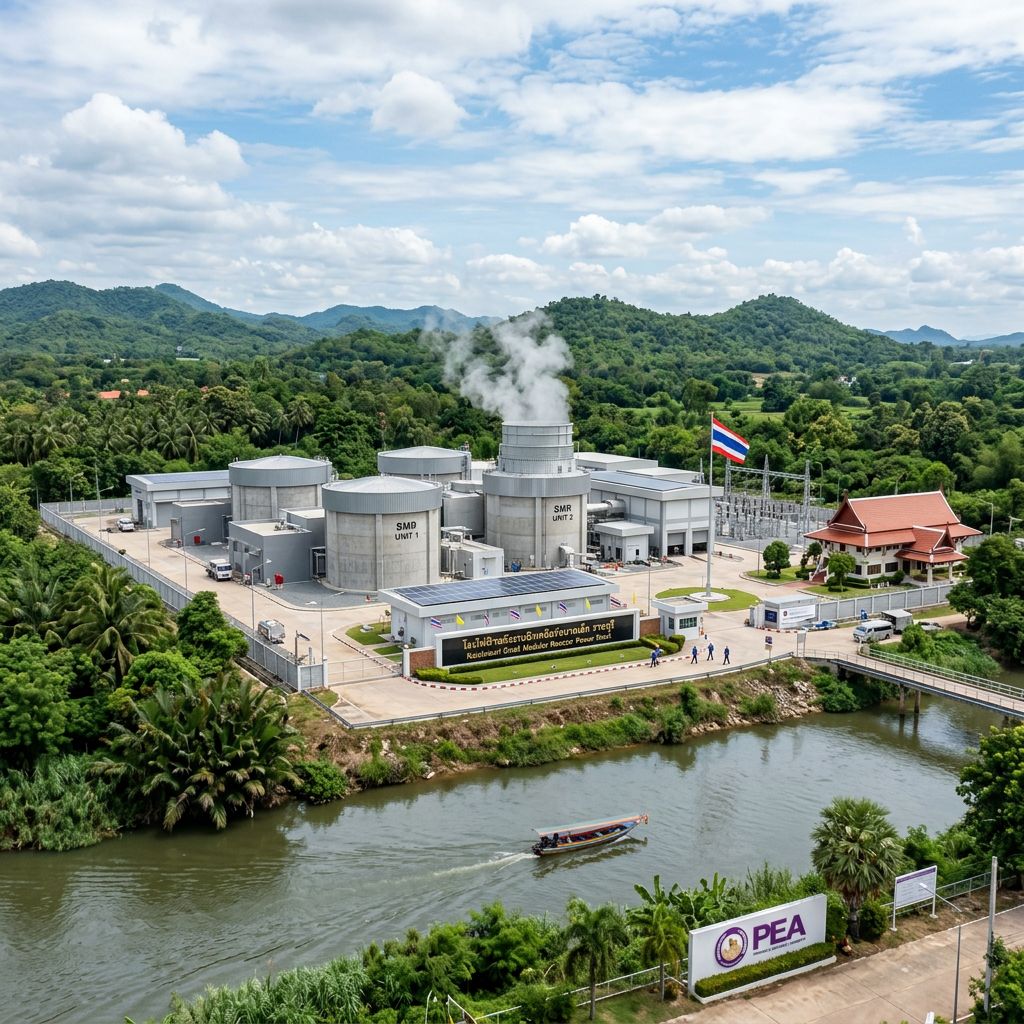
Thailand is preparing to release a draft of its updated Power Development Plan (PDP), with nuclear energy emerging as a major part of the country’s long-term electricity strategy. The proposed plan includes four electricity-supply scenarios, and all four target 9 gigawatts (GW) of installed Small Modular Reactor (SMR) capacity by 2050.
Under the draft plan, Thailand aims to connect its first 300-megawatt (MW) SMR to the national grid by 2037. The first reactor is expected to contribute around 1% of the country’s electricity generation at the time of commissioning. Nuclear capacity would then expand gradually as electricity demand rises across transport, industry and other sectors.
By 2050, SMRs are projected to supply between 16% and 18% of Thailand’s total electricity generation. The government sees nuclear power as an important tool for supporting its target of achieving net-zero greenhouse gas emissions by 2050 while maintaining a reliable electricity supply.
Thailand is also considering greater participation from the private sector. Private companies could potentially be allowed to develop and operate SMR facilities alongside government-led energy projects. This approach could help mobilize additional investment and accelerate the deployment of nuclear technology.
The proposed expansion of SMRs is also linked to changing electricity demand patterns. Growing adoption of electric vehicles, expansion of mass transit systems and increasing industrial activity are expected to raise power consumption. At the same time, peak electricity demand could increasingly shift towards nighttime hours.
SMRs could provide a stable, continuous source of electricity to complement variable renewable sources such as solar and wind. Their ability to provide round-the-clock generation could also support grid stability as Thailand increases its dependence on renewable energy and battery storage.
The draft PDP is expected to undergo public consultation in September. Feedback from stakeholders and the public will then be reviewed and incorporated into the plan before it is submitted to Thailand’s National Energy Policy Council for consideration by the end of the year.
If approved, the updated PDP would mark a significant change in Thailand’s energy strategy. The country would move towards a power system increasingly based on renewable energy, battery storage and nuclear generation, while gradually reducing its dependence on fossil fuels.
Subscribe to get the latest posts sent to your email.








)