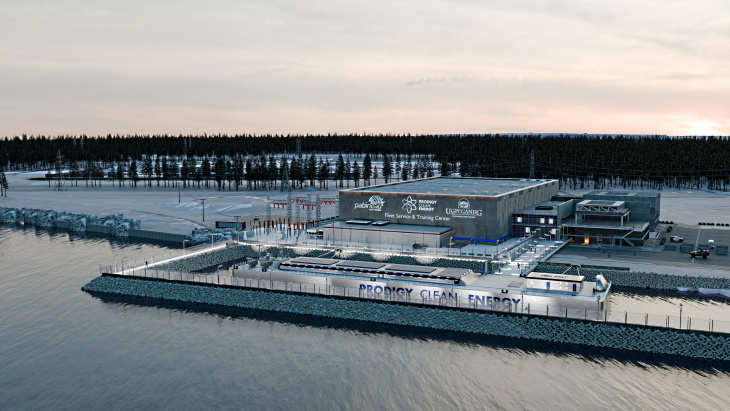
Under an agreement with Pabineau First Nation and Eel River Bar First Nation, the Prodigy Transportable Nuclear Power Plant (TNPP) Pilot Project will be First Nations-owned and validate plant logistics and operational requirements, with the hope of providing the commercial blueprint for a fleet across Canada’s North and global export markets. The proposed pilot project will deploy a commercial electricity-generating facility and construct a new campus in Belledune, featuring: a centralised operations and maintenance hub to monitor and service a Northern TNPP fleet and train future plant workers; and a state-of-the-art Indigenous Energy Innovation Visitor Centre. The power plant itself is expected to generate more than 150 jobs during site preparation and 40 permanent jobs on site. The project targets in-service operation by the early 2030s.
At peak output, the Prodigy Transportable Nuclear Power Plant will supply clean baseload energy to power up to 40,000 homes. The provincial government of New Brunswick has signed a Letter of Intent to offtake the generated electricity, and has formally notified Natural Resources Canada of its institutional support and intent to advance the project to Canada’s federal Major Projects Office as a nationally transformative infrastructure initiative.
“The modular power plant infrastructure is reactor agnostic, offering scalable power output customisation and flexibility for coastal marine or land installation,” Prodigy said. “TNPPs can be factory-built, shipped and installed in about 18 months, providing a rapidly-deployed clean and reliable energy solution for Northern ports, communities, defence installations and critical mineral operations. The plant arrives at the deployment location fully assembled, ready for fuelling and related fuel-in commissioning. By optimising logistics, TNPPs resolve remote construction risks, significantly reducing nuclear project CAPEX, environmental impact, and accelerating delivery timelines. The power plant is purpose-designed to be completely removed at the end of its operational life for centralised decommissioning, eliminating concerns around legacy waste.”
In the coming months, the project team will establish the proponent venture organisation and initiate critical-path activities, including site selection and characterisation in readiness for licensing, and finalising the down selection of a reactor technology demonstrably ready by 2032 for commercial electricity generation. Collectively, these actions lay the groundwork for submitting the Licence to Prepare Site application, with the objective of achieving a Final Investment Decision within 18 months. A qualified nuclear operating organisation – to become the facility licensee – will be procured during the initial planning phase of the project.
“The successful integration of microreactors and Transportable Nuclear Power Plants into Canada’s Northern and Arctic energy portfolio begins with demonstrating a commercially operating facility south of 60 in an established nuclear jurisdiction,” said Mathias Trojer, president and CEO of Prodigy Clean Energy. “This deployment strategy is consensus-driven, reflecting years of dedicated engagement with Northern Indigenous Rights Holders, provincial and federal governments, utilities, and industry. Prodigy is honoured to partner with Pabineau First Nation, Eel River Bar First Nation, and the province of New Brunswick on this historic initiative.”
“We in Pabineau First Nation are proud to partner with Eel River Bar First Nation, Prodigy, and the province of New Brunswick, to lead in providing a solution for energy security and food security for our brothers and sisters in the Northern regions of Canada,” said Chief Terry Richardson, Pabineau First Nation. “By integrating this Canadian clean baseload energy technology with Indigenous ownership and economic participation, this initiative establishes a replicable model to deploy transportable nuclear power infrastructure across Canada, especially in Northern and Arctic regions where energy sovereignty is vital to community prosperity and economic reconciliation. This project will further demonstrate an export-ready power plant for markets outside of Canada, generating prosperity not only for Indigenous Peoples and New Brunswick, but also for the country as a whole.”
Chief Chris George, Eel River Bar First Nation, added: “Prodigy has put First Nations first since day one, prioritising deep consultation, mutual learning, community capacity building, and Indigenous equity leadership. Eel River Bar First Nation is excited to work with Pabineau First Nation, Prodigy, and the Government of New Brunswick to progress the project through public engagement and key permitting milestones.”
Prodigy is developing two sizes of facilities: the Prodigy Microreactor Power Station TNPP and the SMR Marine Power Station TNPP, which can integrate different sizes and types of nuclear reactors. The company says its Transportable Nuclear Power Plants are not barges with reactors onboard – they are purpose-designed, marine-fabricated buildings qualified to house operating nuclear reactors. All systems and components are contained within the plant, reducing the need for additional land-based buildings. They are customisable from 1-1000 MWe gross output, and can be tailored for high-heat applications.
In March 2024, Prodigy Clean Energy and Des Nëdhé Group – an Indigenous Economic Development Corporation – signed a memorandum of understanding to develop opportunities to power remote mines and communities in Canada using Prodigy microreactor Transportable Nuclear Power Plants. Under the MoU, Prodigy and Des Nëdhé were to explore potential TNPP projects, and engage with First Nations, Inuit, and Métis across Canada, identifying ways in which Indigenous Peoples could have ownership in TNPP new builds, and how an Indigenous workforce could take a leading role in TNPP commercialisation and strategic infrastructure development.