Tuesday, 4 March 2025
The company building the Hinkley Point C nuclear power plant in southwest England had originally been given planning permission in 2013 for a scheme with low velocity cooling water intake heads and a fish return system to minimise the numbers of fish getting sucked into the plant’s cooling water system. It also involved having 280 underwater speakers to blast out noises to keep fish away from the intake areas.
However, EDF later said that the “fast-flowing tides and poor visibility posed significant risks for divers. This was not considered acceptable for mitigating the size of the remaining impact on the local fish population and as a result, the project has recently been exploring the creation of new areas of saltmarsh habitat around the Severn as a compensation measure”.
The proposal to drop the acoustic fish deterrent plan and create more than 800 acres (324 hectares) of saltmarsh instead, has faced local opposition in community consultations and legal challenges have threatened to add to delays for the nuclear power plant project.
The new acoustic fish deterrent
EDF says the “innovative” new type of acoustic fish deterrent “was not known to us when we launched meetings with communities last year”. It involves using ceramic transducers to make targeted very high-frequency sound and “we are working with experts to provide the scientific data to underpin the case for its use at the new power station”. It says it is a fairly new technology deployed in the fishing industry to reduce by-catch and had not been considered for use for a power station before.
The company says it would not require a lot of power, so high voltage power cables would not be needed and it can be lowered into place and maintained from the surface without the need for divers. Tests with fish tagging have already begun, which EDF says show that salmon “tend to move in the main channel away from the intake heads”.
EDF says that the high-frequency system will be tuned to “maximise the effectiveness of fish deterrence whilst minimising impacts on larger marine mammals like seals and dolphins”.
It says the technology is “proven and deployed internationally. This new type of acoustic fish deterrent is now the project’s preferred solution and we are working with experts to provide the scientific data to underpin the case for using it at Hinkley Point C”.
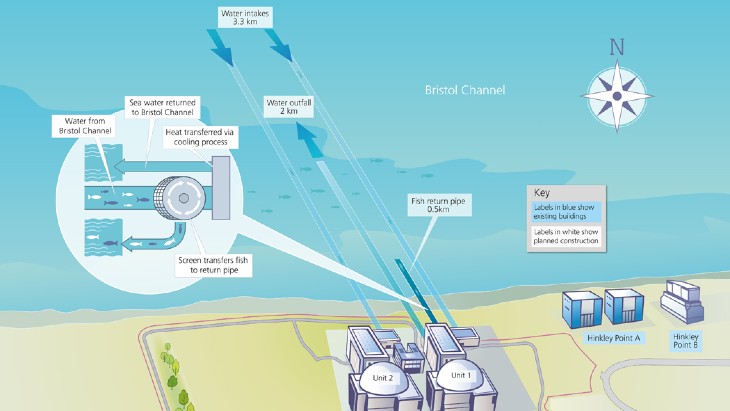
The acoustic fish deterrent system aims to stop fish entering the water intakes (Image: EDF)
In its statement EDF adds: “While work to prove the effectiveness of the new acoustic fish deterrent will continue throughout 2025, we are pausing all design and development work on saltmarsh creation.
“We are not currently planning any further consultation on saltmarsh creation and we hope that it will no longer be required. However, until the scientific work on the acoustic fish deterrent is complete, we are not yet able to rule out the need for saltmarsh creation, or other compensation measures like improvements to weirs in the future. ”
The Environment Agency estimates that even without an acoustic fish deterrent system the impact on fish in the Severn Estuary from the new power station would be 44 tonnes per year, “less than the actual catch of one small fishing vessel”, with the fish deterrent system aiming to slash that figure further.
What are the planning implications?
There have been plans to submit a material change application to the original planning consent for Hinkley Point C, but, if the new deterrent system works, there will not be a need to get updated permission for the removal of an acoustic fish deterrent system and replacement with compensatory saltmarshes.
However, EDF says it will still submit its application for a material change to the permission in 2026, because of proposals to change the way used fuel is stored and also changes to some other “on-site infrastructure such as the retention of a substation”.
While EDF says that until the new system is proven to work it cannot “rule out the need for saltmarsh or improvement to weirs further up the Severn Estuary. We remain bound by current environmental regulations which require compensation should an acoustic fish deterrent not be fitted”.
The Hinkley Point C project
Construction of Hinkley Point C – composed of two EPR pressurised water reactors of 1630 MWe each – began in December 2018, with unit 1 of the plant originally scheduled to start up by the end of 2025, before that was revised to 2027 in May 2022. Last year, EDF announced that the “base case” was now for unit 1 being operational in 2030, with the cost revised from GBP26 billion (USD32.8 billion) to between GBP31-34 billion, in 2015 prices.
When complete, the two EPR reactors will produce enough carbon-free electricity for six million homes, and are expected to operate for as long as 80 years.