Tuesday, 1 April 2025
Speaking at the 6th International Arctic Forum, Likhachev said: “The volume of cargo has already amounted to tens of millions of tonnes with last year’s record of nearly 38 million tonnes. Our northern deposits developers tell us to be prepared for hundreds of millions of tonnes … now we need 11 icebreakers, which we already have (including eight nuclear icebreakers). We must move on to the next stage and plan 100 and 150 million tonnes and 15 to 17 icebreakers instead of 10 or 11. Therefore, we must construct them.”
He added: “An icebreaker does not transport cargo, so we need a cargo fleet. I understand that we do not have enough capacity to meet the demand for cargo vessels in advance, and this is where international cooperation is necessary. We have a very good understanding of business on the international market. Now we are having discussions with several countries that are experts in shipbuilding.”
The conference also heard about growing cooperation between Russia and both China and India on the Northern Sea Route, as well as discussion about the possible development of tourism and hospitality in the Arctic, especially in the developing ‘nuclear cities’ as part of measures to attract young professionals to live and work there.
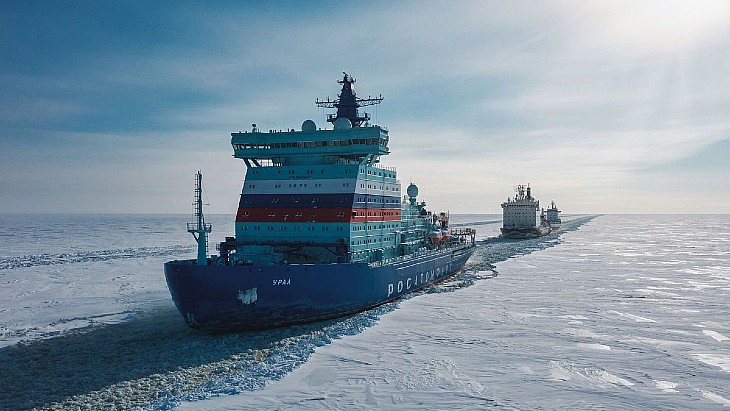
There are currently a series of Project 22220 nuclear-powered icebreakers operating – the Arktika, Sibir and Ural – or under construction – the Yakutia, Chukotka and Leningrad. Last week, over several days a floating crane was used to load the generator, condenser, turbine and other components onto the Chukotka. Later this year the Stalingrad will be laid down.
The Project 22220 vessels are 173 metres long, 34 metres wide and with a height from the waterline to the mainmast of 57 metres. They are designed to break through ice up to three metres thick and have a speed of 22 knots in clear water. The RITM-200 is a pressurised water reactor with a thermal capacity of 175 MW, which converts to 30 MW at the propellers. It is 7.3 metres high with a diameter of 3.3 metres and an integral layout which its manufacturers say means it is lighter, more compact and 25 MW more powerful than previous generations used on nuclear-powered icebreakers. The service life is 40 years.
There is also a larger nuclear-powered icebreaker under construction, the Rossiya, which will be the first of the proposed Project 10510 nuclear-powered icebreakers. It will feature two RITM-400 reactors for a propeller power of 120 MW. It will be able to penetrate ice up to 4.3 metres thick and clear a channel up to 50 metres wide. Its most recent reported construction target service date is 2030.
Ice conditions ‘not improving’
Russian President Vladimir Putin also visited the International Arctic Forum, where he heard from Director General of FSUE GlavSevmorput Sergey Zybko that at the time there were 50 vessels in the Northern Sea Route and nine nuclear and non-nuclear icebreakers working.
Zybko said that AI was being used to analyse satellite radar images and he said that global warming was not yet making the ice conditions better for the trade route, which runs the length of Russia’s northern coast from Europe to Asia.
He said: “It should be noted that the ice conditions have been deteriorating over the past few years. And although we often hear about global warming, current research by the Arctic and Antarctic Research Institute does not confirm this. According to their observations, no significant changes in ice cover are expected in the winter-spring period until 2050.”