By

What if we told you that something was adding upward pressure to the price of every gallon of gasoline sold in the United States, and it has nothing to do with the Strait of Hormuz or global energy markets?
Get the Latest US Focused Energy News Delivered to You! It’s FREE:
This week’s American Energy Snapshot explores how record-high biofuel mandates are affecting the price of gasoline, and how the EPA’s Renewable Fuel Standard program can be adjusted to help reduce costs.
First, what is the Renewable Fuel Standard?
The Renewable Fuel Standard (RFS) is the government program that sets how much biofuel must be used. Although biofuels play an important role in America’s fuel supply, there are practical limits.
Here’s how the RFS works: Each year, the EPA announces how many gallons of biofuels must be blended into the nation’s fuel supply. That requirement is called the Renewable Volume Obligation (RVO). Refiners and fuel importers must then prove to the government that they met the requirement by submitting credits called Renewable Identification Numbers, or RINs.
RINs can be thought of as the “currency” of the RFS program. A RIN is generated with every gallon of biofuel produced (one per gallon of ethanol; higher-energy fuels like renewable diesel generate more than one). Once the biofuel is blended with gasoline or diesel, the RIN is “separated” and can be traded on the open market. Companies have three ways to get RINs: blend biofuels they produce, blend biofuels they purchase, or buy RINs on the open market.
That last option is important because RINs are traded — like commodities — on financial markets. And just like commodities, RIN prices rise and fall with the balance of supply and demand. This year, demand for RINs is currently outpacing supply, and prices are near record highs.
The problem with this year’s record-high renewable volume obligation
The EPA’s latest RVOs set record-high biofuel volume requirements — the largest in the program’s two-decade history. For 2026, companies must submit 26.81 billion RINs, equal to about 15.5% of every gallon of gasoline and diesel sold in the country.
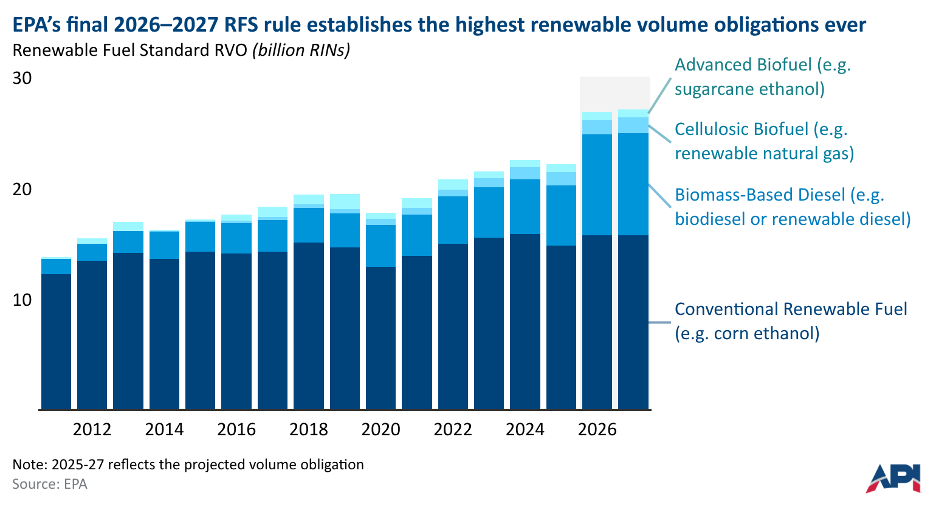
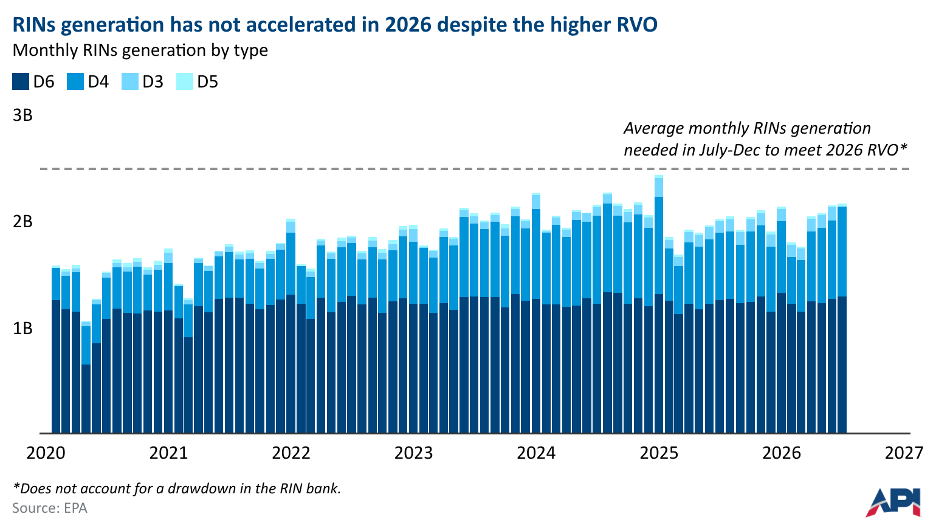
There is nothing inherently wrong with higher volumes of biofuels. If the biofuel requirement increases along with the production of biofuels (and their RINs), the market can adjust. But right now, the RVOs appear to be set higher than the volume of biofuels — and therefore RINs — on the market. That creates a problem.
The price of RINs has surged to all-time highs
With the RFS program requiring more RINs than are currently being generated, the market has bid up the price of compliance with the RFS. RIN prices have more than doubled since the start of 2026.
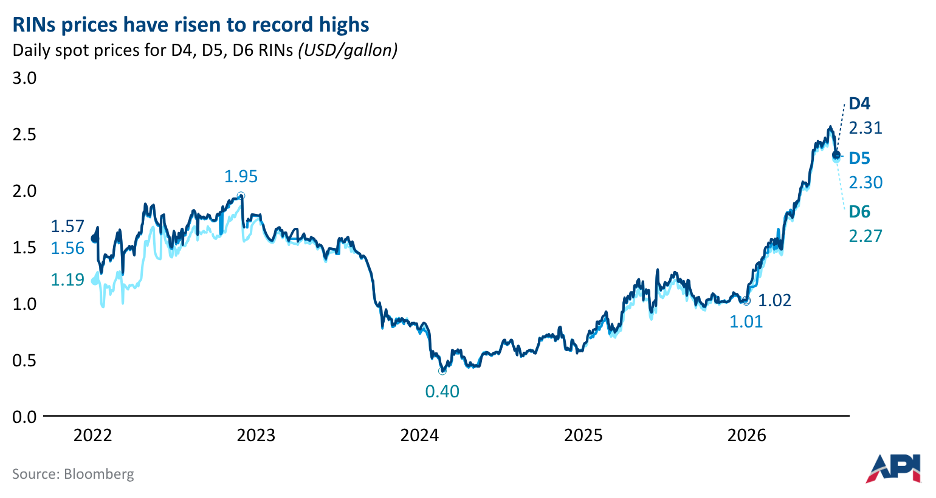
The RIN credits companies buy to show compliance now cost roughly twice what they did in January 2026.
How can RIN prices be brought down?
Fortunately, adjusting the RFS does not require an act of Congress. EPA currently has statutory authority to adjust mandates it has already set to reflect market conditions.
Aligning the RVO closer with the volume of biofuels producers can realistically supply would help ease the RIN scarcity that is contributing to higher compliance costs.
The takeaway
Unlike global disruptions, the RVO is a domestic policy choice. Right-sizing it could quickly reduce compliance costs and help relieve pressure on fuel prices without reducing the important role renewable fuels play in America’s energy mix.
Share This:
More News Articles