Monday, 2 December 2024
_91109.jpg)
Exploration work on the Gorleben rock salt formation as a potential radioactive waste repository site began in 1977. The federal government gave its approval for underground exploration at the site in 1983, and excavation work began with the sinking of the first of two shafts in 1986. Work continued until June 2000 when, alongside plans for the eventual phaseout of nuclear power in Germany, a three- to ten-year moratorium was imposed on the Gorleben exploration work. This moratorium was lifted in March 2010.
In July 2014, the federal government and the state government of Lower Saxony agreed that the mine workings that had been kept in operation and the surface installations would be scaled back to just the size needed to keep the mine open. In addition, the safety installations were reduced to the level of a normal industrial facility. Underground, the areas that were no longer needed in order to keep the mine open have been decommissioned and sealed off.
On 28 September 2020, waste management organisation Bundesgesellschaft für Endlagerung (BGE) published a list of potential storage sites for Germany’s radioactive waste. The list followed parliament’s approval three years earlier for a science-based search for a site. It identified 90 areas covering 54% of the country’s surface area as potentially geologically suitable. After the application of minimum requirements and exclusion criteria, 139 salt domes were initially under consideration as a repository site. However, the Gorleben salt dome and 78 other salt domes were excluded from the site selection process by applying the geoscientific weighing criteria. The Gorleben mine was officially closed in September 2021.
BGE announced in August 2023 that it had awarded a consortium comprising Redpath Deilmann GmbH and Thyssen Schachtbau GmbH a contract to backfill the mine using the salt stored above ground. Around 400,000 tonnes of rock salt are currently stored there on a salt heap.
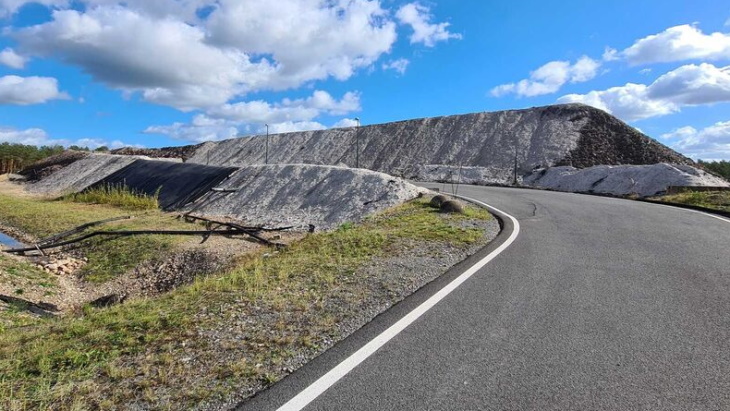 The salt heap at Gorleben (Image: BGE)
Loaders and excavators have since been delivered for the upcoming work, a road milling machine was brought to the dump and the contractor’s operating team was instructed.
First, the road milling machine will work the surface of the pile to loosen the salt. It throws the loosened rock salt into a container towed by a tractor. Four containers loaded with salt rock are to be brought underground every hour. One container can hold around 15 tonnes of rock. Work will be carried out around the clock in three shifts: in the morning and midday shifts, only salt is transported underground. During the night shift, maintenance and repair work is carried out.
BGE estimates it will take about three years to completely fill the pit. The shafts will then be filled and the site will be demolished. The complete demolition is scheduled to be completed by 2031. After that, BGE will be released from its responsibility under mining law and the site will be returned to the owner – the DWK (German Society for the Reprocessing of Nuclear Fuel). BGE noted it is not involved in the plans for the subsequent use of the site.
“The start of the backfilling of the Gorleben mine shows that we are keeping our word and closing the mine,” said Iris Graffunder, chairwoman of the BGE management board. “The Gorleben salt dome no longer plays a role in the site selection process.”