Friday, 16 May 2025
Belgium’s federal law of 31 January 2003 requires the phase-out of all nuclear electricity generation in the country. Under that policy, Doel 1 was originally set to be taken out of service on its 40th anniversary – 15 February 2015. However, the law was amended in 2013 and 2015 to provide for Doel 1 to remain operational for an additional ten years. Duel 3 was closed in September 2022 and Tihange 2 at the end of January 2023. Unit 1 of the Tihange plant is set to shut in October this year, with Doel 2 following in December.
Belgium’s last two reactors – Doel 4 and Tihange 3 – were scheduled to close in November 2025. However, following the start of the Russia-Ukraine conflict in February 2022 the government and Electrabel – the Belgian subsidiary of Engie – began negotiating the feasibility and terms for the operation of the reactors for a further 10 years, with a final agreement reached in December, with a balanced risk allocation.
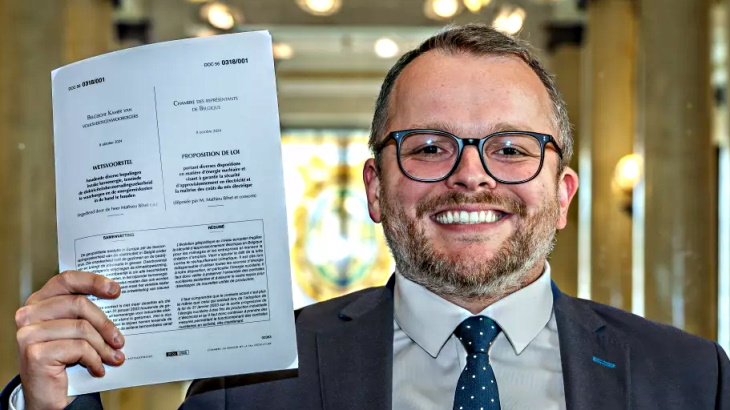
was submitted to parliament in July last year by Member of Parliament Mathieu Bihet, prior to him becoming the country’s energy minister, together with his colleagues, calling for the nuclear phase out policy to be revoked.
During a 15 May plenary session, the Chamber of Representatives, the lower house of parliament, passed the legislation – referred to as the ‘Bihet Law’ – with 102 votes in favour, eight against and 31 abstentions.
“This day will go down in history as a turning point in Belgian energy history,” the government said. “By approving with a large majority the law that heralds the return of nuclear energy in our country, the federal parliament leaves behind two decades of blockages and hesitations to pave the way for a realistic and resilient energy model.
“By opening the door to new nuclear capacity, the government confirms its desire to strengthen our energy independence, guarantee competitive prices and accelerate the decarbonisation of our production.”
“With this new law, Belgium is finally giving itself the means to guarantee an energy mix that is based on today’s reality,” Energy Minister Bihet said. “It is no longer a matter of pitting energy sources against each other in a binary and sterile way, but of using them pragmatically and complementary.”
The government said the implementation of the reform will be carried out in consultation with industrial players, sector experts and safety authorities.
Industry welcomes reversal
The approval of the law was welcomed by the Belgian Nuclear Forum, which said the phase-out law had “turned out to be an aberration, with negative consequences for Belgian energy policy that we feel to this day … this aberration is now being rectified, the outdated nuclear exit law is relegated to the history books”.
Serge Dauby, managing director of the Belgian Nuclear Forum, added: “It is not just a symbolic victory, this is really a historic milestone. At last, we as Belgium, a country with an enormous amount of nuclear know-how, are signaling to the rest of the world that we are once again taking a rational look at energy policy and the climate challenge, by no longer ideologically excluding nuclear energy as part of the solution.”
“At the same time, this is only a first – but necessary – step in the nuclear revival. To successfully realise the nuclear revival, we urgently need to gather all stakeholders in a ‘task force’. We have already lost too much time during the last legislature. We need a realistic and fact-based long-term strategy for Belgian energy policy. Our industry and our citizens deserve a serious approach, away from ideological dogmas. The nuclear sector is already putting itself at the disposal of the Minister of Energy to help him and his administration achieve our country’s goals of energy transition and energy security.”
Denmark to consider nuclear
Forty years ago, in 1985, the Danish parliament passed a resolution that nuclear power plants would not be built in the country.
But in a parliamentary vote on Thursday, two-thirds of Danish MPs supported the country launching an investigation into the possible use of nuclear power to enhance its energy security.
“Denmark has no recent experience with nuclear power, which is why it is important that we start analysing the potential,” Minister for Climate, Energy and Utilities Lars Aagaard was cited as saying by Reuters. “Can this technology complement what will be dominant in our country: solar and wind? We all know that of course we can’t have an electricity system based on solar and wind alone. There has to be something else to support it.”
He added: “Can we say with confidence that this technology is safe? Where do we dispose of the nuclear waste? Are our authorities prepared if something goes wrong? And so on and so forth. We don’t have that knowledge, but we need it.”
A report on the potential benefits of new nuclear power technologies is expected to be completed next year, Aagaard said in a public hearing in parliament on 14 May.
Article researched and written by WNN’s