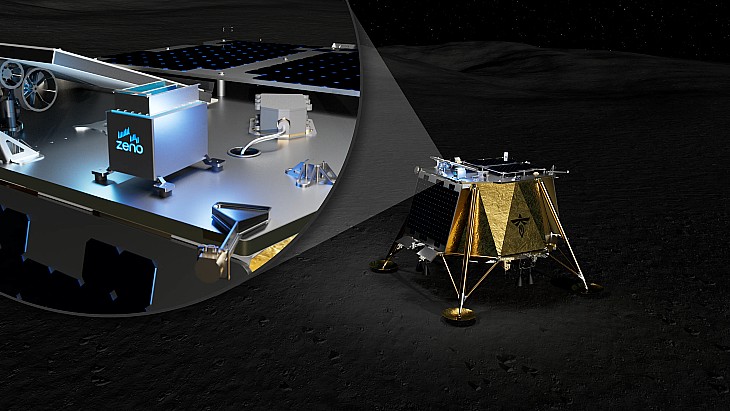
Zeno Power Systems’ Survive-the-Night Package, including a 5 watts (thermal) americium-241 radioisotope heater unit (RHU), will be on board a Firefly mission scheduled to launch no earlier than 2028. The mission will demonstrate Zeno’s technologies designed to enable spacecraft, lunar infrastructure, and future Moon Base systems to operate through the extreme cold and prolonged darkness of the lunar night.
The mission is part of NASA’s Commercial Lunar Payload Services (CLPS) initiative. Upon landing on the near side of the Moon, Blue Ghost will first operate multiple NASA CLPS payloads using solar power for a full lunar day – equivalent to about 14 Earth days. Zeno’s payload will then operate during the lunar night and transmit operational data back to Earth.
The thin lunar atmosphere is unable to trap the Sun’s energy, making for extreme differences in temperature between day and night: according to NASA, temperatures near the Moon’s equator can reach over 250°F (121°C) in daylight, falling to -208°F (-133°C) after nightfall. In deep craters near the Moon’s poles, which are permanently shadowed, the Moon’s surface is even colder.
Surviving the lunar night is therefore one of the most complex challenges of lunar exploration. RHUs have long been used on satellites and in spacecraft to keep instruments warm enough to function efficiently. These have typically been powered using plutonium-238 to generate about 1 watt – China’s Chang’e 4 mission, which landed on the far side of the Moon in 2019 has used a plutonium-powered unit to heat it through multiple lunar nights – but the isotope is now in short supply.
Zeno’s RHU is designed with a novel fuel and shielding system to deliver high specific power from americium-241. As well as the RHU, Zeno’s payload comprises a dedicated platform that includes structural, communications, electrical power, command and data handling, and thermal management subsystems. The RHU generates passive thermal energy through the natural decay of the radioactive material, providing continuous heat without relying on solar power and keeping critical spacecraft components operational during the lunar night or in regions that never receive direct sunlight.
“Hardware capable of surviving the extreme cold of the lunar night will be essential to enabling sustained operations on the Moon,” Zeno Power CEO and co-founder Tyler Bernstein said. “NASA’s Moon Base Program has identified the need for technologies such as radioisotope power systems to support future lunar exploration, and Zeno is proud to answer that call to demonstrate this capability aboard Firefly’s Blue Ghost mission.”
Firefly’s first Blue Ghost mission – Blue Ghost Mission 1, named Ghost Riders in the Sky – took place in early 2025, with what the company described as the first fully successful commercial Moon landing. It completed more than 14 days of surface operations during daylight and just over 5 hours of operations into the lunar night.
“Our first Blue Ghost mission gave us firsthand insight into the Moon’s extreme thermal environment, where we measured temperatures ranging from more than 230°F during the lunar day to below -275°F at night,” said Vice President of Spacecraft at Firefly Aerospace Ray Allensworth. “Now we’re looking forward to advancing technologies that can extend missions beyond sunset and support long-duration surface operations required for NASA’s Moon Base initiative and the growing lunar economy.”
Zeno Power and Firefly’s announcement was made the day before US President Donald Trump to “reinvigorate” US space transport policy and enable over 1,000 launches and reentries on American soil annually by 2030.