Monday, 3 March 2025
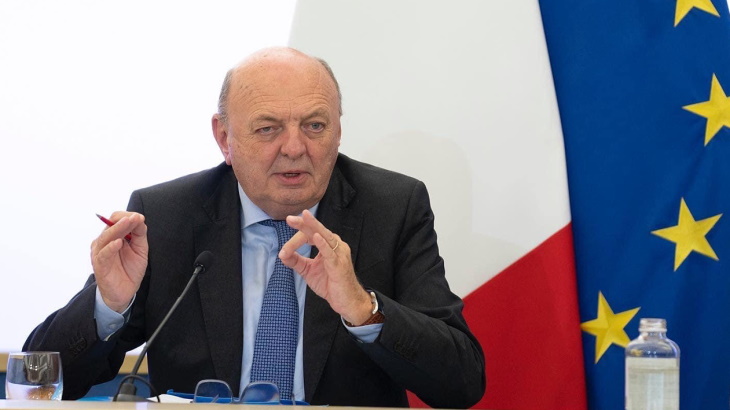
On 28 February, on the proposal of President Giorgia Meloni and the Minister of the Environment and Energy Security Gilberto Pichetto Fratin, the Council of Ministers (the Italian cabinet) approved the draft delegation law on ‘sustainable nuclear energy’.
The government said the text is aimed at “the inclusion of sustainable nuclear and fusion in the so-called ‘Italian energy mix’ and intervenes organically from an economic, social and environmental perspective, within the framework of European decarbonisation policies with a time horizon of 2050, consistently with the objectives of carbon neutrality and security of supply”.
It added that the intervention aims to: ensure continuity of energy supply in the presence of a constant increase in demand and promote the achievement of energy independence; contribute to the decarbonisation objectives necessary to tackle climate change; and ensure the sustainability of costs borne by end users and the competitiveness of the national industrial system.
The draft law says that Italy should make “a clear break … with respect to the nuclear plants of the past” and “use of the best available technologies, including modular and advanced technologies”. It calls for the government to establish an independent authority for the regulation, supervision and control of nuclear infrastructures.
“Promoters of nuclear projects must provide adequate financial and legal guarantees to cover the costs of construction, operation and decommissioning of the plants and for risks, even those not directly attributable to them, arising from nuclear activity,” it adds.
The draft law requires the government to adopt a series of legislative decrees, within 12 months of entry into force, to “organically regulate the entire life cycle of the new sustainable energy, through the drafting of a national programme: from the testing, localisation, construction and operation of the new reactors, to the issue of manufacturing and reprocessing of the fuel will be addressed in a circular economy vision”. It will also “serve to provide training and information tools, train new technicians and professionals in the sector, and identify benefits for the territories involved”.
The draft law will now be submitted to parliament for final approval.
“With the latest generation nuclear, together with renewables, we will be able to achieve the objectives of decarbonisation, guaranteeing the full energy security of the country,” Minister Pichetto Fratin said. “In this way, Italy is ready to face the challenges of the future.”
The background
Italy operated a total of four nuclear power plants starting in the early 1960s but decided to phase out nuclear power in a referendum that followed the 1986 Chernobyl accident. It closed its last two operating plants, Caorso and Trino Vercellese, in 1990.
In late March 2011, following the Fukushima Daiichi accident, the Italian government approved a moratorium of at least one year on construction of nuclear power plants in the country, which had been looking to restart its long-abandoned nuclear programme.
The public mood has changed since then, and in May 2023, the Italian Parliament approved a motion to urge the government to consider incorporating nuclear power into the country’s energy mix. In September last year, the first meeting was held of the National Platform for a Sustainable Nuclear, set up by the government to define a time frame for the possible resumption of nuclear energy in Italy and identify opportunities for the country’s industrial chain already operating in the sector.
Italy’s government included potential nuclear capacity – up to 16 GW/20-22% of capacity by 2050 – in its National Integrated Energy and Climate Plan, which was submitted to the European Commission on 1 July 2024.
Speaking the following day at the Global Energy Transition Congress in Milan, Pichetto Fratin, said: “We expect to be able to reach about 8 GW from nuclear power by 2050, covering more than 10% of the nation’s electricity demand. This percentage may increase to over 20-22% by fully exploiting the potential of nuclear power in our country.”