Friday, 7 March 2025
_10914.jpg)
The Safety Significant Confinement Ventilation System (SSCVS) is part of the US Department of Energy Office of Environmental Management’s major project to significantly increase airflow underground in the Waste Isolation Pilot Plant (WIPP) in New Mexico. Increased airflow will mean that activities to emplace sealed waste drums in underground rooms mined out of the ancient salt formation can take place at the same time as facility mining and maintenance operations.
The ventilation system will work in tandem with a new utility shaft, and will pull air through the repository, remove salt when required and send the air through HEPA filtration units before releasing it to the environment. (HEPA – for High Efficiency Particulate Air – filters are mechanical air filters that can remove at least 99.97% of dust, pollen, mold, bacteria, and any airborne particles down to a size of 0.3 microns.) The SSCVS includes two primary buildings: the Salt Reduction Building, which pre-filters salt-laden air from the underground repository; and the New Filter Building, which houses fans and 22 HEPA filtration units. The new system will increase underground airflow from 170,000 cubic feet (4814 cubic metres) per minute to a maximum of 540,000 cubic feet per minute.
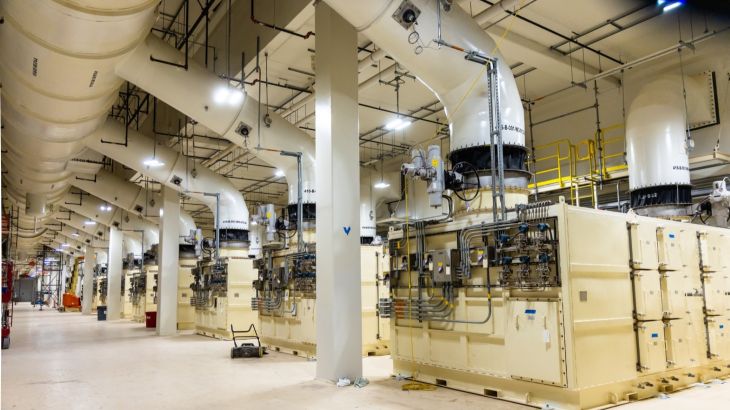
HEPA filters inside the SSCVS facility (Image: DOE EM)
Construction of the SSCVS was completed in June. During the commissioning phase, WIPP management and operations contractor Salado Isolation Mining Contractors have tested each system individually and then the SSCVS as a whole to demonstrate complete functionality. Following commissioning, the SSCVS has now been turned over to the operations team members so they can gain proficiency in running the highly efficient system.
Assessments will now be carried out to show the SSCVS is fully integrated into other WIPP site systems, demonstrating that all primary and backup systems are functional and operating as expected, and that operators are proficient and fully understand the ventilation system. When all the reviews have been completed and approved by the US Department of Energy Office of Environmental Management, the SSCVS will be connected to the repository’s underground ventilation system.
Construction of the SSCVS began in 2018, when it was estimated that the system would cost USD288 million with completion envisaged for November 2022. Progress was impacted when WIPP, like most of the Office of Environmental Management’s field sites, focused on essential mission-critical operations during the COVID-19 pandemic. According to a , by 2024 the cost estimate had risen to USD494 million.
WIPP is the USA’s only repository for the disposal of transuranic, or TRU, waste which includes clothing, tools, rags, residues, debris, soil and other items contaminated with small amounts of plutonium and other man-made radioactive elements from the US military programme. The repository is excavated out of a natural rock salt layer 650 metres below ground, and has been operational since 1999.