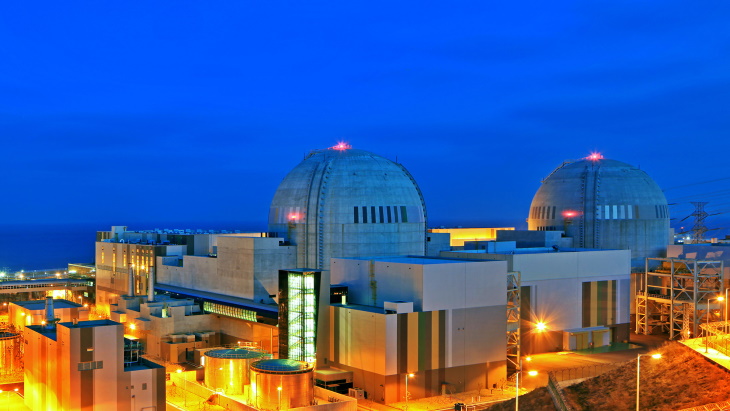
Rising seawater temperatures are causing some nuclear power plants to reach temperatures approaching the design seawater temperature, the Nuclear Safety and Security Commission (NSSC) said. The design sea water temperature refers to the maximum temperature of seawater at which the reactors can operate safely.
In a report to the NSSC at a meeting on 14 August, Korea Hydro & Nuclear Power (KHNP) presented its response measures to secure cooling performance of nuclear power plant equipment as seawater temperatures rise.
KHNP has gradually been raising the operating limit seawater temperature by utilising the margin within a range that does not affect safety while maintaining the cooling facilities as they are. However, going forward, the company plans to improve cooling performance through facility improvements.
According to KHNP’s analysis, it is expected that Shin Wolsong 1 and 2 will reach the design sea water temperature in 2030, Hanbit 3 and 4 in 2031, and Hanbit units 1, 2, 5 and 6 in 2034, Chosun Biz reported.
KHNP said it has already completed facility improvements (by increasing the plate size of the existing heat exchanger) at units 1 and 2 of the Shin Wolsong plant, which are estimated to reach the limit seawater temperature for operation within the next ten years, and is planning to move forward with raising the limit seawater temperature for operation at those units.
At units 1-6 of the Hanbit plant, KHNP plans to replace the existing tubular heat exchanger by the first half of 2029. For its other nuclear power plants, the company plans to pursue facility improvements in the mid to long-term after conducting cooling performance evaluations.
“Based on actual seawater temperature measurements, seawater temperature rise rate research data, etc, we plan to proactively respond by evaluating the expected time when the seawater temperature limit for each nuclear power plant will be reached annually and establishing a seawater temperature prediction system,” KHNP said.
At the meeting that day, members of the NSSC agreed that “more proactive efforts to improve facilities are needed, taking into full consideration the climate change situation”.
“In order to prepare for accelerated global warming, we must quickly improve facilities so that we can fundamentally solve the problem, and we must do everything possible to respond immediately when high sea temperatures are observed,” said NSSC Chairman Choi Won-ho. “The Nuclear Safety and Security Commission plans to conduct periodic inspections to ensure that facility improvements are implemented without a hitch.”
According to the Korea Institute of Ocean Science and Technology, the average water temperature in the East Sea rose by 8.3°C between 1980 to 2010, while it rose by 1°C between 2021 and 2023.