Deep Isolation was among the recipients of USD36 million in funding announced in March 2022 by the US Department of Energy (DOE) for 11 projects seeking to increase the use of nuclear power as a reliable source of clean energy and to limit the amount of radioactive waste produced from advanced reactors. The awards were made through the DOE Advanced Research Projects Agency-Energy’s (ARPA-E’s) Optimising Nuclear Waste and Advanced Reactor Disposal Systems (ONWARDS) programme. ONWARDS was launched in 2021 as ARPA-E’s first programme created to identify and facilitate technologies for advanced reactor used fuel recycling, waste forms, used fuel disposal pathways and associated advanced safeguards technologies.
In one project – titled Enabling the Near Term Commercialisation of an Electrorefining Facility to Close the Metal Fuel Cycle – which received a USD4 million grant, Deep Isolation was joined by Oklo Inc and the Argonne and Idaho national laboratories to commercialise a fuel recycling facility that will include, for the non-recyclable waste, the development of a final waste solution compatible with a deep borehole repository. The Oklo-led project was the first focused programme to identify pathways to reduce waste material and minimise the need for disposal sites, and was the first federally-funded programme to explore pairing a commercial borehole solution with a recycling facility for an advanced reactor developer.
In the project, Deep Isolation analysed the waste streams that would be generated by the electrorefining facility to identify waste forms suitable for a deep borehole repository. It would also establish the technical and cost savings framework for using deep borehole repositories as a complement to electrorefining. Oklo and Argonne would focus on industrialising fuel recycling through advanced automation techniques and sensor technologies.
Deep Isolation has now said its analysis has “confirmed that nuclear waste streams partitioned through the Argonne-baseline electrorefining process are compatible with deep borehole disposal, demonstrating a safe and practical pathway for permanent isolation. Physics-based modelling showed that high-level waste, when disposed of in Deep Isolation’s deep borehole system within generic shale and granitic host rocks, achieved long-term safety levels surpassing targets set in developing the model and achieving exposure levels that were several orders of magnitude below a stringent radiological exposure dose standard”.
It added: “The results of this comprehensive initiative provide confidence that borehole disposal could serve as a viable option for high-level radioactive waste from advanced reactor fuel recycling, highlighting a potential pathway for closing the metal fuel cycle if US law is changed to authorise borehole repositories for high-level waste.”
Jesse Sloane, Executive Vice President of Engineering, Deep Isolation, said: “This collaboration with Oklo represents an important step forward for the advanced reactor ecosystem and our deep borehole disposal solutions for nuclear waste. By pairing innovation in fuel recycling with advanced deep geologic disposal technology, we are helping build the technical foundation for a fully integrated, sustainable nuclear future.”
The borehole technology
Disposal in deep boreholes – narrow, vertical holes drilled deep into the earth’s crust – has been considered as an option for the geological isolation of radioactive wastes since the 1950s. Deep borehole concepts have been developed in countries including Denmark, Sweden, Switzerland, and the USA but have not yet been implemented.
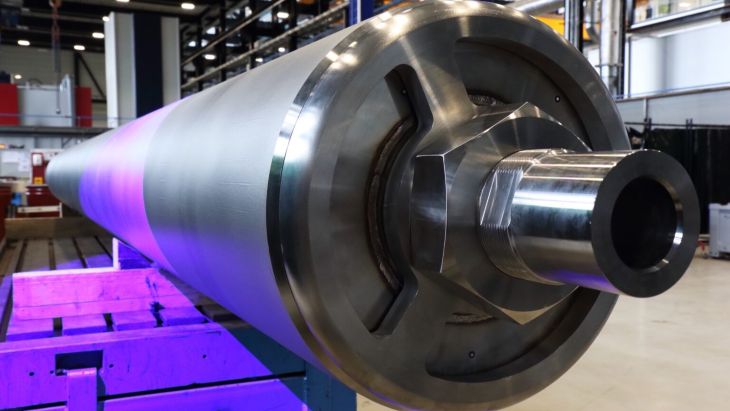
Deep Isolation’s patented technology leverages standard drilling technology using off-the-shelf tools and equipment that are common in the oil and gas drilling industry. It envisages emplacing nuclear waste in corrosion-resistant canisters – typically 9-13 inches (22-33 centimetres) in diameter and 14 feet long – into drillholes in rock that has been stable for tens to hundreds of millions of years. The drillhole – which is lined with a steel casing – begins with a vertical access section which then gradually curves until it is nearly horizontal, with a slight upward tilt. This horizontal ‘disposal section’ would be up to two miles (3.2 kilometres) in length and lie anything from a few thousand feet to two miles beneath the surface, depending on geology. Once the waste is in place, the vertical access section of the drillhole and the beginning of its horizontal disposal section would be sealed using rock, bentonite and other materials.
Deep Isolation’s Universal Canister System (UCS) – developed in collaboration with NAC International Inc through a three-year project funded by the DOE’s Advanced Research Projects Agency–Energy (ARPA-E) – is designed to accommodate a range of advanced reactor waste streams, including vitrified waste from reprocessing, TRISO used fuel, and halide salts from molten salt reactors. It is compatible with modern dry storage and transport infrastructure, and meets performance and safety requirements across both borehole and mined repository options, which gives greater flexibility and reduced uncertainty in future waste disposition, the company says.
In January, Deep Isolation said that a two-year research project, also funded by the DOE’s ARPA-E programme, subjected its UCS to the kinds of conditions found thousands of feet below the surface had shown materials used in its fabrication perform reliably and remain resistant to corrosion over time.
Last month, Deep Isolation announced the launch of its multi-year, full-scale, at-depth deep borehole demonstration programme to test its technology for safely and permanently disposing of nuclear waste deep underground.