Wheeler River is the largest undeveloped uranium project in the eastern portion of the Athabasca Basin, in northern Saskatchewan, and is host to the high-grade Phoenix and Gryphon uranium deposits. The project is a joint venture between Denison (90% and operator) and JCU (Canada) Exploration Company Limited (10%). Permitting efforts for the planned Phoenix in-situ recovery (ISR) operation began in 2019.
As part of Denison’s strategy to effectively harmonise the Federal and Provincial Environmental Assessment (EA) for the Phoenix ISR project, the Provincial EA was submitted for final approval in November 2024 after Denison successfully completed multiple key milestones in the Federal regulatory process, including completion of the Canadian Nuclear Safety Commission’s rigorous technical review phase, and acceptance by the CNSC of the company’s final Environmental Impact Statement for the project.
“As a result of this approach, the Federal and Provincial EAs for the project are substantially the same and no subsequent revisions for conformance are expected to be required,” Denison said.
Denison noted that permitting efforts are now nearing completion with approval of the project’s EA received from the Province of Saskatchewan and CNSC hearing dates set later this year for Federal approval of the EA and project construction licence.
“We thank the Province of Saskatchewan for entrusting Denison to proceed with the development of the project, which is expected to set a superior standard of sustainability as the first ISR uranium mine in Canada,” said Denison President and CEO David Cates. “Importantly, completion of the provincial EA represents one of the final regulatory milestones necessary for Denison to commence construction of the Phoenix ISR mine, which is on track to become Canada’s next new large-scale uranium mine.”
In ISR – also known as in-situ leach, or ISL – minerals are recovered from ore in the ground by dissolving them in situ, using a mining solution injected into the orebody. The solution is then pumped to the surface, where the minerals are recovered from the uranium-bearing solution. More than half of the world’s uranium production is now produced by such methods, although they have not yet been used in Canadian uranium mining operations.
Potential of ISR studied at Midwest
Denison has also announced the results of the Preliminary Economic Assessment (PEA) completed for ISR mining of the Midwest Main uranium deposit at its 25.17%-owned Midwest project, also in the Athabasca Basin region.
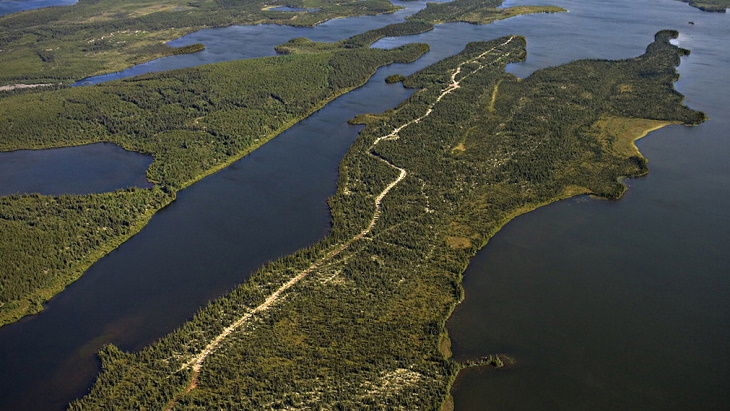
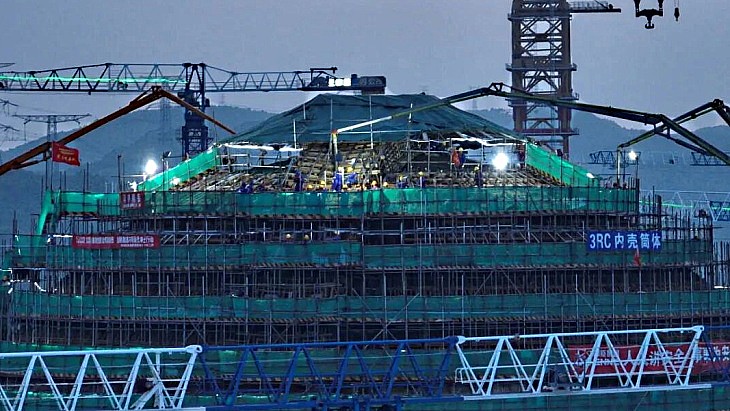
Midwest (Image: Denison Mines Corp)
The PEA outlines total ISR mine production (on a 100% basis) of 37.4 million pounds U3O8 (14,386 tU) over a mine life of about six years, resulting in annual average production of nearly 6.1 million pounds U3O8 (2,346 tU).
“The PEA highlights that the ISR mining method has the potential to be a technically sound and economically robust means to extract significant uranium production from the high-grade Midwest Main deposit with low initial capital costs, a high rate of return, and rapid payback,” Denison said.
Midwest Main is one of two high-grade unconformity-hosted uranium deposits at the Midwest joint venture, co-owned by Denison (25.17%) and Orano Canada Inc (74.83%). Orano Canada is the operator of Midwest, which is about 25 kilometres by road from the McClean Lake uranium mill, owned by Denison-Orano Canada, where processing of uranium-bearing solution from Midwest is assumed to occur.
“The Midwest PEA illustrates tremendous technical and economic potential for ISR mining at Midwest Main,” Cates said. “While preliminary in nature, the study incorporates the findings of our 2023 and 2024 field test programmes, which provided support for key ISR criteria necessary for the application of the mining method and demonstrates the potential for robust economics. The project is estimated to have an all-in cost of production amongst the lowest cost uranium mines in the world, benefitting from a powerful combination of low initial capital costs and low cash operating costs.”
Denison noted that the mineral resource estimate for Midwest Main has been updated and now stands at 38.7 million pounds U3O8 in indicated mineral resources (510,000 tonnes at 3.5% U3O8), plus 12.6 million pounds U3O8 in inferred mineral resources (905,000 tonnes at 0.64% U3O8).
In parallel to the continued evaluation of the potential use of the ISR mining method at Midwest, Denison said the project owners are also “advancing the assessment of the use of the Surface Access Borehole Resource Extraction (SABRE) mining method for extraction of the Midwest Main deposit”. SABRE is a proprietary mining method owned by Denison and Orano Canada, and currently being used at the McClean North deposit.
SABRE is a non-entry, surface-based mining method that uses a high-pressure water jet placed at the bottom of a drill hole to excavate a mining cavity. The cuttings from the excavation process are then air-lifted to the surface, separated and stockpiled. The method is the culmination of a mining equipment invention and development initiative that began in 2004.