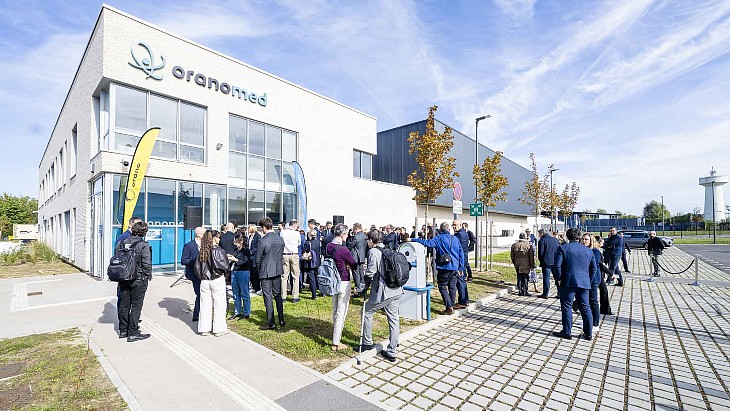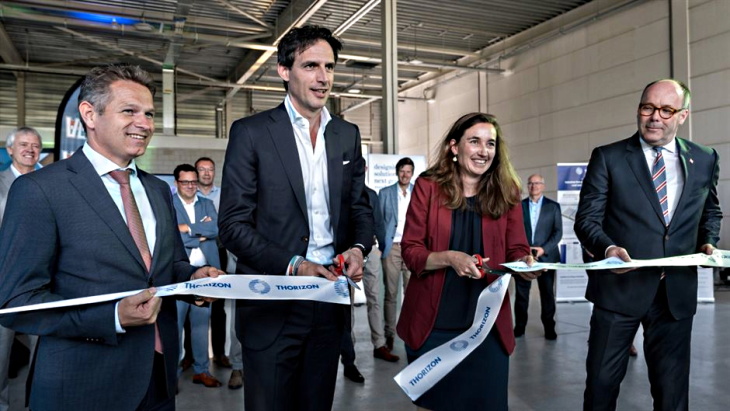
The launch of the test facility came during a visit by Dutch European Commissioner for Climate, Net Zero and Clean Growth Wopke Hoekstra to the High Tech Campus together with a delegation from the Dutch government, the Province of North Brabant and industry representatives. Together with Kiki Lauwers – the CEO of Dutch-French molten salt reactor (MSR) developer Thorizon – Hoekstra officially opened the facility by cutting the ribbon. The event was attended by State Secretary for Climate and Green Growth Jo-Annes de Bat, Provincial Executive Member for Economic Affairs Martijn van Gruijthuijsen and technology leader Peter Wennink.
“The energy transition is one of the greatest challenges facing Europe and the world today,” Hoekstra said. “Nuclear energy must be part of the energy mix. Molten salt reactors are an important step towards stable, reliable and clean energy for Europe, helping to safeguard Europe’s energy independence. It is inspiring to see such innovation taking place in the Netherlands.”
The test facility is being developed through the PROMOSA project. In January 2025, Brabant-based technology companies Demcon, Thorizon and VDL Group signed a project agreement to develop and test technology for MSRs. The PROMOSA project focuses on demonstrating and validating the manufacturability, safety, and functionality of critical components and non-nuclear (sub)systems of these reactors. All components will be tested in high-temperature molten salt, without the use of nuclear fuel. The work is to be carried out in collaboration with the Dutch Institute for Fundamental Energy Research (DIFFER), a leading research institute in Eindhoven in Noord-Brabant province.
In March last year, the province said it would contribute 50% of the total project costs of EUR8 million (USD9.3 million), with the remaining financing coming from the companies themselves. The funding is being provided by the innovation coalition ‘Nuclear Energy for the Future’, which was launched by Noord-Brabant in 2021 with the goal of leveraging the manufacturing industry and research institutes in the province to accelerate the development of MSRs. The province previously invested in a research facility at DIFFER.
The DIFFER research institute conducts leading-edge research on fusion energy and chemical energy and supports the development of MSRs through its unique DICE (DIFFER Irradiation-Corrosion Experiment) research facility, where the interaction between corrosion, heat, and radiation is studied to optimise material choices.
The PROMOSA project forms part of the Nuclear Innovation Coalition, established by the Province of North Brabant in 2022 to strengthen collaboration between governments, companies and knowledge institutions and to build a leading position in safe, next generation nuclear energy.
Thorizon said the test facility “represents a major milestone on the path towards building its first reactor, the Thorizon One, which has been designated by the European Commission as one of eight flagship projects for the accelerated development of small modular reactors”.
“Thanks to the support of the province and the collaboration with strong manufacturing partners such as VDL Groep and Demcon, we can build, test and prepare our technology for serial production,” Lauwers said. “Brabant has truly become an accelerator for our project in Europe.”
Thorizon – a spin-off from NRG, which operates the High Flux Reactor in Petten in the Netherlands – is developing a 250 MWt/100 MWe MSR, targeted at large industrial customers and utilities. The company plans to begin constructing its first reactor, Thorizon One, around 2030. Thorizon collaborates with industry leaders such as Orano, Tractebel and EDF, and its project has been selected by the European Commission and the French government under the France 2030 investment plan.
MSRs use molten fluoride salts as primary coolant, at low pressure. They may operate with epithermal or fast neutron spectrums, and with a variety of fuels. Much of the interest today in reviving the MSR concept relates to using thorium (to breed fissile uranium-233), where an initial source of fissile material such as plutonium-239 needs to be provided.