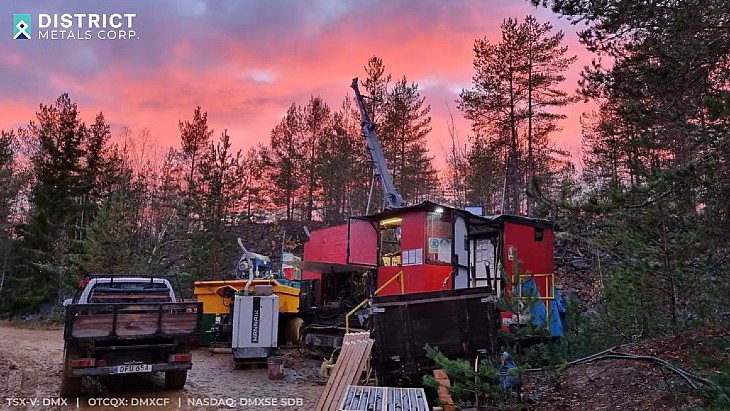
The Canadian company first announced the results of its assessment in early June, envisioning a conventional open-pit mining and processing operation with average annual production of 3.3 million pounds U3O8 (1269 tU) over a mine life of 13 years, as well as producing vanadium and potash.
A Preliminary Economic Assessment – or PEA – is, as its name suggests, an early-stage review of a mining project’s potential economics, and can include Inferred Mineral Resources – resources that are more geologically speculative than Indicated or Measured resources. But a Preliminary Economic Assessment is seen as a significant step in the potential development of a project, setting the scene for a company to move on to prefeasibility and feasibility studies.
District said that the mine process plan includes about 77% Indicated mineral resources and 23% Inferred mineral resources.
Speaking when the results of the PEA were released, District CEO Garrett Ainsworth, CEO described the study as a “transformational milestone”, with “globally significant” results which “position the Viken Deposit amongst the most compelling development opportunities for important and critical raw materials in the mining sector today”.
The report, Preliminary Economic Assessment on the Viken Energy Metals Project, Jämtland County, Sweden, was prepared by independent P&E Mining Consultant Inc with input from METS Engineering Group Pty Ltd in accordance with Canadian National Instrument 43-101 – Standards of Disclosure for Mineral Projects, or NI 43-101 for short. It has now been .
Law enacted
Sweden is estimated to have more than one million tonnes of uranium resources in alum black shales (schists) in three deposits. Uranium exploration and mining was banned from 2018 under amendments to the country’s environmental code, but in November 2025, Sweden’s parliament voted to repeal the ban on uranium mining and exploration. The new legislation took effect on 1 January.
A second piece of legislation has now been enacted to confirm that uranium mining will no longer be regulated as a nuclear facility and that consequently uranium extraction will no longer require explicit municipal consent. This follows the passage of a bill in June, removing the requirement for a separate assessment under the Swedish Environmental Code as well as the requirement for municipal approval. These changes were enacted on 15 July.
Australian-based company Aura Energy’s Häggån deposit, also located in the province of Jämtland, contains vanadium, nickel, molybdenum, zinc and potash as well as uranium. The enactment of the new legislation “confirms that uranium mining will no longer be regulated as a nuclear facility and that consequently uranium extraction will no longer require explicit municipal consent”, the company said.