Thursday, 3 July 2025
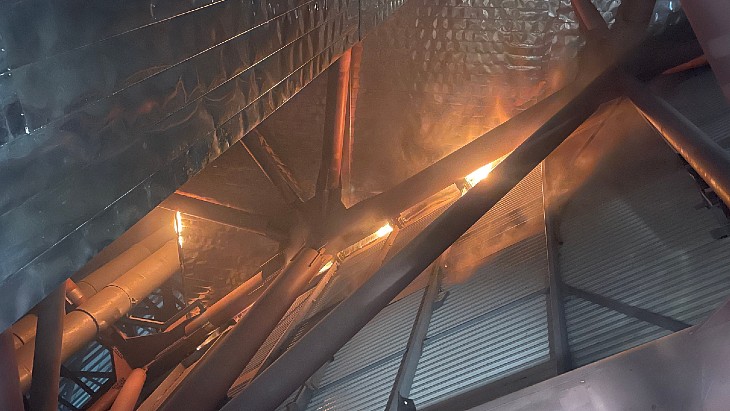
The European Union will contribute EUR25 million, the United Kingdom will contribute EUR6.7 million and France EUR10.6 million. The pledges came during a meeting of the International Chernobyl Cooperation Account held at the European Bank of Reconstruction and Development (EBRD).
The EBRD said the drone strike: “Has severely affected the New Safe Confinement’s two primary functions: (i) containing radiological hazards and (ii) supporting long-term decommissioning. Key systems designed to ensure the NSC’s 100-year lifespan have been rendered non-operational, with a significant risk of further deterioration in the absence of swift emergency repairs. While it is difficult to provide an accurate estimate of the cost of repairs to the NSC at the moment, the scale of the damage and the complex radiological environment suggest that the total cost of the emergency works could exceed EUR100 million.”
Chernobyl NPP said the contributions “are a crucial step toward ensuring the continuation of the New Safe Confinement restoration work”.
A grant agreement was signed on Wednesday between the plant in Ukraine and the EBRD to fund a project which aims to assess the damage and develop a plan of emergency repairs to the outer cladding and membrane, which were damaged by the drone and subsequent fire.
The work also involves assessing the state of the concrete structures, end walls and foundations and a detailed plan of work to carry out the repairs.
Balthasar Lindauer, EBRD Nuclear Safety Department Director, said the pledged donations were a “manifestation of the international community’s unwavering support” for Chernobyl.
The shelter
Chernobyl unit 4 was destroyed in the April 1986 accident (you can read more about it in the ) with a shelter constructed in a matter of months to encase the damaged unit, which allowed the other units at the plant to continue operating. It still contains the molten core of the reactor and an estimated 200 tonnes of highly radioactive material.
However it was not designed for the very long-term, and so the New Safe Confinement – the largest moveable land-based structure ever built – was constructed to cover a much larger area including the original shelter. The New Safe Confinement has a span of 257 metres, a length of 162 metres, a height of 108 metres and a total weight of 36,000 tonnes and was designed for a lifetime of about 100 years. It was built nearby in two halves which were moved on specially constructed rail tracks to the current position, where it was completed in 2019.
It has two layers of internal and external cladding around the main steel structure – about 12 metres apart – with both breached in the drone incident. The NSC was designed to allow for the eventual dismantling of the ageing makeshift shelter from 1986 and the management of radioactive waste. It is also designed to withstand temperatures ranging from -43°C to +45°C, a class-three tornado, and an earthquake with a magnitude of 6 on the Richter scale.
According to World Nuclear Association, the hermetically-sealed New Safe Confinement allows “engineers to remotely dismantle the 1986 structure that has shielded the remains of the reactor from the weather since the weeks after the accident. It will enable the eventual removal of the fuel-containing materials in the bottom of the reactor building and accommodate their characterisation, compaction, and packing for disposal. This task represents the most important step in eliminating nuclear hazard at the site – and the real start of dismantling”.
The New Safe Confinement was financed via the Chernobyl Shelter Fund which was run by the EBRD. It received EUR1.6 billion (USD1.7 billion) from 45 donor countries and the EBRD provided EUR480 million of its own resources.