Explained: Energy Management Systems (EMS)—The Brain Behind Utility-Scale Solar and Storage

As renewable energy projects become larger and more complex, simply generating electricity is no longer enough. Modern solar plants and Battery Energy Storage Systems (BESS) must continuously respond to changing weather conditions, electricity demand, market prices, and grid requirements. Coordinating these variables requires an intelligent control platform known as the Energy Management System (EMS).

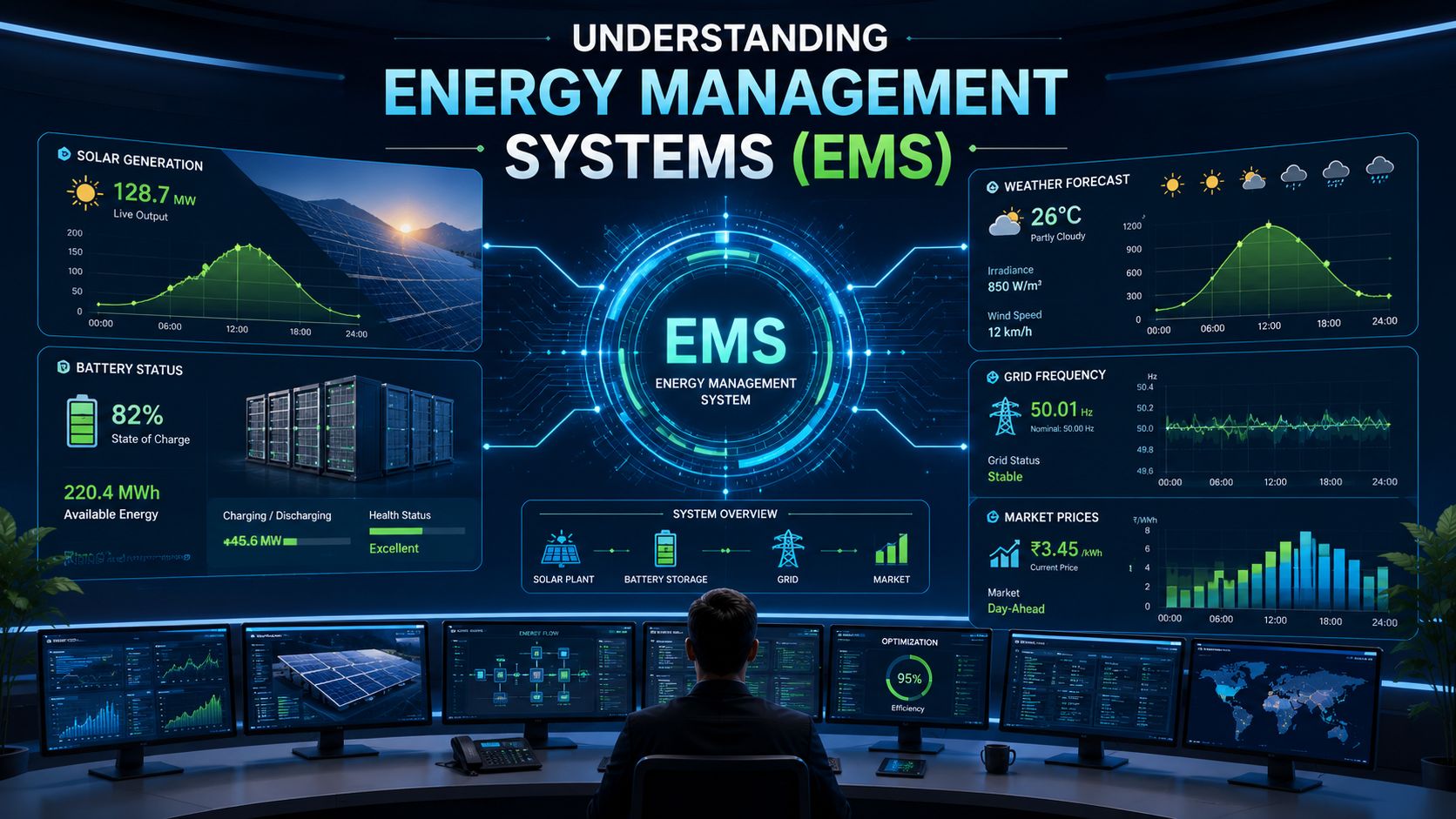
An Energy Management System (EMS) is the central software platform that monitors, controls, and optimizes the operation of renewable energy assets. It analyses real-time data from solar plants, battery storage, weather forecasts, and the electricity grid to determine the most efficient operating strategy. Rather than functioning as a single controller, the EMS serves as the decision-making layer that ensures all connected systems work together efficiently and reliably.

Although these systems work closely together, each serves a distinct purpose. A SCADA (Supervisory Control and Data Acquisition) system collects operational data and enables remote monitoring and control of equipment. A Battery Management System (BMS) focuses specifically on battery safety by monitoring parameters such as voltage, current, temperature, and State of Charge (SoC). The EMS sits above both systems, using their data to optimize overall plant performance, coordinate battery dispatch, and support operational and commercial objectives.

An EMS uses weather forecasting, electricity demand predictions, and real-time market information to determine when batteries should charge, discharge, or remain on standby. By intelligently scheduling energy flows, it maximizes renewable energy utilization, reduces curtailment, supports grid stability, and improves overall plant efficiency. For hybrid projects combining solar, wind, and storage, the EMS ensures that all assets operate as a coordinated system.

As electricity markets become increasingly dynamic, EMS platforms enable renewable plants to participate in energy trading and ancillary service markets. By responding to price signals and grid requirements in real time, operators can improve project revenues while delivering services such as frequency regulation, peak demand support, and load balancing.

The next generation of EMS platforms is incorporating artificial intelligence and machine learning to enhance forecasting accuracy, automate operational decisions, and optimize asset performance. As renewable energy deployment continues to accelerate, the Energy Management System is becoming the digital brain that enables cleaner, smarter, and more flexible power systems.


Subscribe to get the latest posts sent to your email.
 

  • Related Posts

    Top Stories Of The Day: Brookfield Launches Lumara; MNRE Revises ALMM Order; POWERGRID Floats BESS Tender; NLC Wins 900 MW Solar; PSPCL Plans Digital Net Metering and More…

    Brookfield has launched Lumara, a new renewable energy platform backed by a US$600 million investment, reinforcing its long-term commitment to India’s clean energy sector. The platform will focus on accelerating…

    Vikran Engineering Secures INR 120.69 Crore POWERGRID Contract for 400 kV GIS Substation Package SS-147

    Vikran Engineering Limited has secured a ₹120.69 crore contract from Power Grid Corporation of India Limited (POWERGRID) for the 400 kV GIS Substation Package SS-147, strengthening its order book and…

    Have You Seen?

    Agricultural company launches CCS operations at Kansas ethanol plant

    • July 31, 2026
    Agricultural company launches CCS operations at Kansas ethanol plant

    Top Stories Of The Day: Brookfield Launches Lumara; MNRE Revises ALMM Order; POWERGRID Floats BESS Tender; NLC Wins 900 MW Solar; PSPCL Plans Digital Net Metering and More…

    • July 31, 2026
    Top Stories Of The Day: Brookfield Launches Lumara; MNRE Revises ALMM Order; POWERGRID Floats BESS Tender; NLC Wins 900 MW Solar; PSPCL Plans Digital Net Metering and More…

    Video | Linde Q2 results at-a-glance

    • July 31, 2026
    Video | Linde Q2 results at-a-glance

    Explained: Energy Management Systems (EMS)—The Brain Behind Utility-Scale Solar and Storage

    • July 31, 2026
    Explained: Energy Management Systems (EMS)—The Brain Behind Utility-Scale Solar and Storage

    Vikran Engineering Secures INR 120.69 Crore POWERGRID Contract for 400 kV GIS Substation Package SS-147

    • July 31, 2026
    Vikran Engineering Secures INR 120.69 Crore POWERGRID Contract for 400 kV GIS Substation Package SS-147

    Week in Middle East: Oman Floats 3 GW Tender; BP Plans Lightsource Sale; Shanxi Wins Oman EPC; DEWA Expands Globally; Oman Revises RE Rules and More…

    • July 31, 2026
    Week in Middle East: Oman Floats 3 GW Tender; BP Plans Lightsource Sale; Shanxi Wins Oman EPC; DEWA Expands Globally; Oman Revises RE Rules and More…

    Oil Companies Signing Agreements in Venezuela, But Delays Persist

    • July 31, 2026
    Oil Companies Signing Agreements in Venezuela, But Delays Persist

    New Bill introduced to increase CDR technologies

    • July 31, 2026
    New Bill introduced to increase CDR technologies

    Jakson Green’s Odisha Renewable Hydrogen and Green Ammonia Project Achieves CertifHy EU Precertification

    • July 31, 2026
    Jakson Green’s Odisha Renewable Hydrogen and Green Ammonia Project Achieves CertifHy EU Precertification

    Linde posts record Q2 sales as electronics demand drives growth

    • July 31, 2026
    Linde posts record Q2 sales as electronics demand drives growth