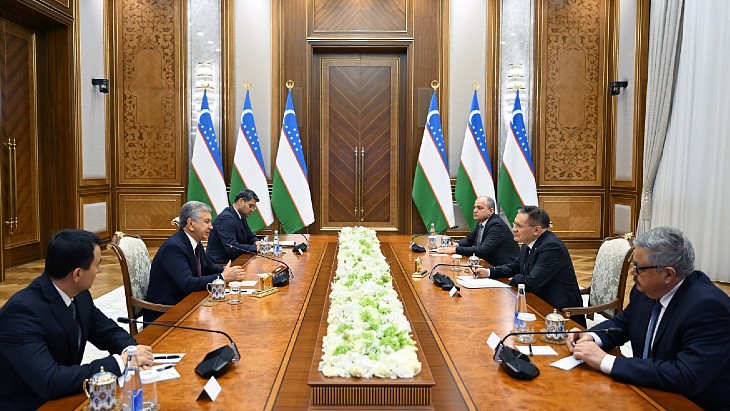
According to the president’s news service the two also talked about “expanding cooperation in the peaceful use of nuclear energy”, in areas such as agriculture and medicine.
First concrete for the first small modular reactor had been expected to be poured in the spring, but a draft government document published last week mentioned December 2026.
That led to the Uzatom Agency publishing a clarification on Monday saying: “We would like to emphasise that the previously announced targets remain in effect, and there is no discussion of any postponement. The date indicated in the draft reflects a conservative scenario, which envisages the completion of all numerous mandatory preparatory and licensing stages by this date.”
Following the talks on Tuesday, Likhachev said: “We are moving forward at a rapid pace and fully on schedule. Work on site is proceeding actively … this year’s main goal is to begin pouring concrete for the foundation slab of the nuclear island buildings. Given the importance of meeting deadlines, we aim to begin concrete preparation work this spring.”
In a subsequent interview with Russia’s Rossiya-24 television channel, as reported by the official Tass news agency, he said: “I think we will pour the first concrete … much earlier than December. Our speed will depend on the customer … this is a regulated event implying receipt of certain licences, permits, qualifications, including for local manufacturers. Nevertheless, our plans are to make it much earlier than December.”
Background
A contract signed in May 2024, during a visit to the country by Russian President Vladimir Putin, was for the construction of a 330 MW capacity nuclear power plant featuring six units of the RITM-200N water-cooled small modular reactor (SMR), which is adapted from nuclear-powered icebreakers’ technology, with thermal power of 190 MW or 55 MWe and with an intended service life of 60 years. The first unit was scheduled to go critical in late 2029 with units commissioned one by one.
It was the first export order for Russia’s SMR. The first land-based version is currently being built in Yakut in Russia, with the launch of the first unit scheduled to take place in 2027.
An agreement signed at the end of September 2025 during World Atomic Week in Moscow multiplied the capacity of what had previously been proposed, with the plant plan switched to feature two large units – VVER-1000s with an output each of 1 GW – plus two 55 MW RITM-200N SMRs.
Excavation work began in October for the pit for the first of the SMRs at the site in the Jizzakh region. About 1.5 million cubic metres of soil will be excavated during the digging of a pit 13 metres deep for the RITM-200N, with engineering surveys and design and preparatory works also under way. Once completed, the new plant will provide for around 14% of Uzbekistan’s electricity demands.