The company – a start-up spun out of the French Alternative Energies & Atomic Energy Commission and Schneider Electric – submitted its application for the creation authorisation decree (DAC) for its Basic Nuclear Installation (INB) Alpha to the French minister in charge of nuclear safety on 19 December.
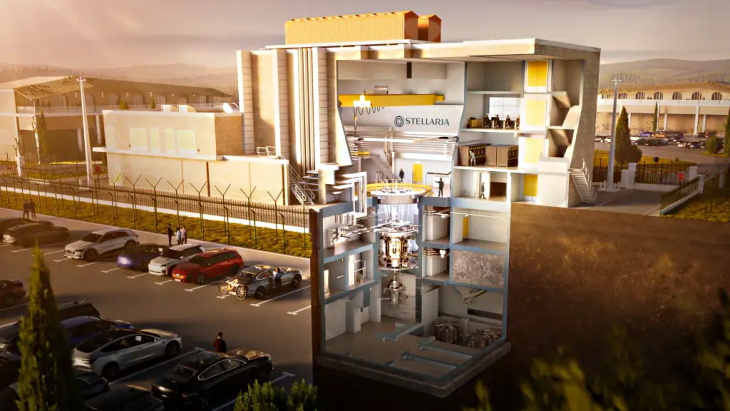
The application concerns the siting and construction of its 100 kW Alvin experimental reactor, scheduled to start up in 2030, in order to launch the test programme that will definitively validate the concept.
The application comprises around 15 documents totalling more than 1,000 pages. It includes: the safety case, including a detailed description of the installation, the safety principles adopted, the analysis of incidents and accidents, including severe accidents, the management of external hazards (earthquakes, flooding, aircraft crashes), as well as radiation protection for workers, the public, and the environment; the environmental impact assessment of the installation; the conditions planned for decommissioning the installation at the end of its lifetime; a presentation of the operator’s technical and financial capabilities; and all technical documents describing the installation in depth, which are essential for the review of the application.
“This new milestone represents a crucial step in the development of the French company and in the implementation of its Stellarium reactor, as it sets out the main principles of the project and officially elevates the start-up to the status of a nuclear operator,” Stellaria said. “To date, Stellaria is the first company to have filed such an application with the authorities in the French fast-neutron nuclear market, and the second among the eleven French start-ups working on the development of SMRs or AMRs, after Jimmy Energy.”
The Stellarium reactor proposed by Stellaria will be very compact (measuring 4 cubic metres) and will be able to use a diversified range of nuclear fuels (uranium, plutonium, mixed-oxide, minor actinides, even thorium). Stellaria says the reactor is “the world’s first reactor to operate with a liquid fuel capable of destroying more waste than it produces”.
Once Alvin has validated Stellaria’s concept, the company plans to build a 10 MWe prototype reactor, MegAlvin.
“2025 marked a turning point for Stellaria,” said Nicolas Breyton, President of Stellaria. “After a structured fundraising round, followed by the signing of a first power pre-order agreement for our reactors with Equinix, the global leader in data centres, the submission of the DAC allows us to reach a new milestone. This step is decisive for Stellaria, as it validates the work carried out so far by its teams and partners, and fully commits the company to its responsibilities as a nuclear operator. By filing this application, Stellaria moves beyond the concept stage and enters a structuring regulatory phase, in which its fundamental choices are now set.”
Molten salt reactors (MSRs) use molten fluoride salts as primary coolant, at low pressure. They may operate with epithermal or fast neutron spectrums, and with a variety of fuels. Much of the interest today in reviving the MSR concept relates to using thorium (to breed fissile uranium-233), where an initial source of fissile material such as plutonium-239 needs to be provided. There are a number of different MSR design concepts, and a number of interesting challenges in the commercialisation of many, especially with thorium.