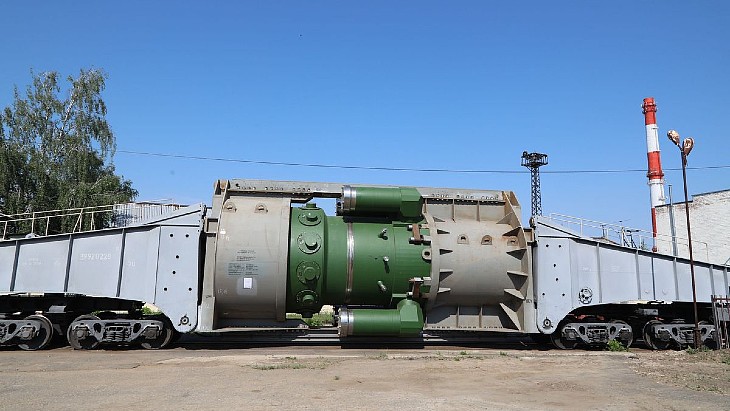
The 58 MWe capacity reactor unit has been manufactured by Rosatom’s Machine-Building division at the ZiO-Podolsk plant near Moscow.
Serial production of the floating power units (FPU-106) is under way to power a copper mining industrial cluster in the Chukotka Autonomous Okrug. This will be the first such project to provide carbon-free energy for industrial production, with four floating power units earmarked for it.
Alexey Likhachev, Director General of Rosatom, said: “Rosatom continues to expand its range of floating power units, and the completion of the first reactor for the lead floating nuclear power unit is a significant milestone. Today, Russia is the only country with an operating floating nuclear power plant, and we intend to maintain our leadership in the development of small-scale technologies, offering innovative and low-carbon energy solutions to our partners in Russia and abroad.”
The RITM-200C is a modification of the RITM-200 reactors in operation on the latest series of nuclear-powered icebreakers. In total, Rosatom’s Machine-Building division is in various stages of producing 14 RITM-200-based reactor units for icebreakers and floating power units.
Russia’s first floating nuclear power plant, the Akademik Lomonosov, has been operating in Chukotka since 2020. During this time, it has generated more than 1.2 billion kWh of electricity and avoided more than 400,000 tonnes of greenhouse gases, Rosatom said.
The state nuclear corporation says that the RITM-200 reactors have proved their effectiveness in Arctic conditions. It says that, in floating power units, they will be able to effectively address current or potential energy shortages in remote, offshore areas. As well as producing floating power units for domestic use, Russia also sees considerable export potential.
According to past presentations, the FPU-106 units would provide 106 MWe, the refuelling interval would be every 5 to 7 years, and there would be a service life of about 40 years. A version of a floating power unit targeting international markets would be 100 MWe with a refuelling interval of 10 years and a service life of 60 years.