Washington State-based Helion says it is the first company in the world to have the regulatory approvals needed to build and operate a fusion power plant.
The Radioactive Materials licence and Radioactive Air Emissions licence confirm that Helion has the facilities, trained personnel, and safety programmes in place at the Orion facility to meet the rigorous safety standards required for fusion operations.
“We are extremely proud to be granted these licences from the Washington Department of Health, making us the first company in the world with the regulatory approvals in place for fusion power plant operations,” said Helion Energy’s David Kirtley. “We have a long history of working with the Department of Health to licence our previous fusion activities. Today’s announcement represents the rigour of that work and opens the door for practical, commercial, safe fusion power.”
The Washington Department of Health (DOH) is the licensing body for fusion power in the state, following the US Nuclear Regulatory Commission’s (NRC) decision to regulate fusion under the byproduct material framework, alongside particle accelerators and hospitals, unlike fission reactors which are regulated by the NRC itself. This distinction “reflects fusion’s fundamentally different safety profile and enables a right-sized path to deployment”, Helion said.
These are the latest in a group of key permits and licences needed for Helion to build and operate its first fusion power plant in Malaga in Washington state, the company said. It is also working toward a transmission interconnection agreement with Chelan County Public Utility District, in what will be the first such agreement for a fusion power plant.
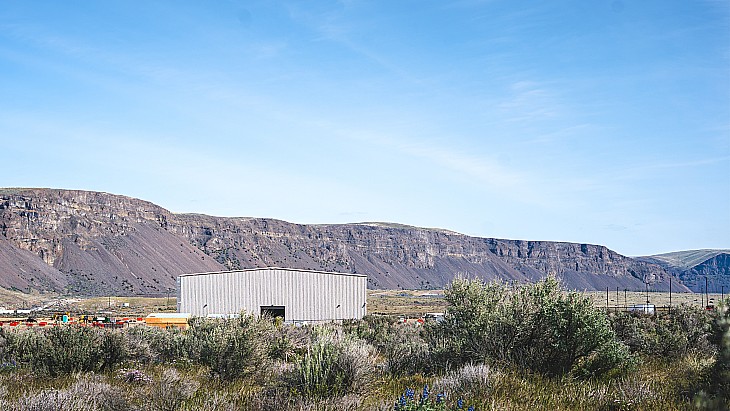
Helion began construction of buildings to support the Orion fusion plant last July, on land it is leasing from the Chelan County Public Utilities District. Construction of the assembly and office building is now complete. Now, the company said, it can proceed with work on the generator building, for which initial earthwork began earlier this year.
Helion says its approach to fusion energy differs in three main ways from other approaches: its pulsed fusion system keeps its fusion device smaller than other approaches, and allows it to adjust the power output based on need; its system is built to directly recover electricity, while other fusion systems heat water to create steam to turn a turbine; and it uses deuterium and helium-3 as fuel, which helps keep its system small and efficient.