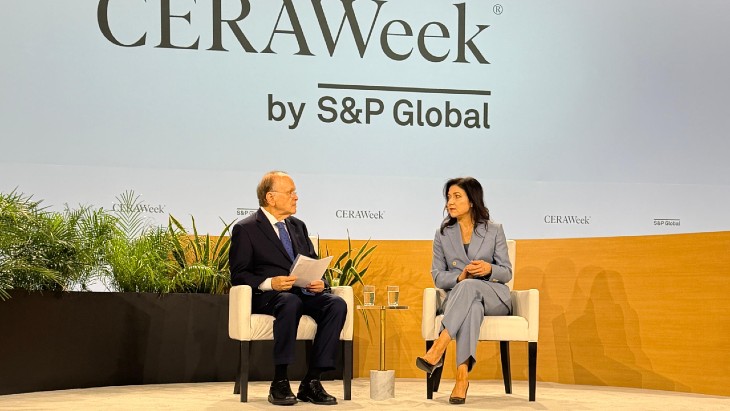
Speaking at the CERAweek international energy event in Houston, Texas, she said that prices of petrol, diesel and jet fuels in Germany were spiking “but we don’t see any scarcities in terms of volume – but if the conflict doesn’t end we [will] see this probably later in April or May”.
She added that the longer the crisis continues the more stress will be put on the “fragile recovery of Germany’s economy”. Of the country’s reliance on gas, she said previous governments decided to phase out coal because of the climate targets, and “the phaseout of nuclear was a huge mistake, a huge mistake and we miss this energy”, which she said had provided 20 GW of CO2-free power production at affordable prices.
There was a need to change course, Reiche said: “It doesn’t mean that we give up all sustainability aims … but it’s a balance – affordability, abundant energy and energy security have to come in the centre. We concentrated on climate protection, we underestimated affordability – that was a mistake that we are going to correct.”
Germany, like other countries, wanted to keep its industrial base, and it needed to have competitive energy prices to help that happen, she said.
She also said that the “current situation shows how vulnerable global energy supply chains are and how quickly geopolitical conflicts become real economic risks. Dependence on geographically concentrated energy flows is a structural risk. Our answer is more diversification, more resilience and an energy policy that brings together security of supply, affordability and sustainability.”
The European Union needed to focus on competitiveness again, and admit that the green deal and the “green premium” had not proved to be a way to stay competitive with the rest of the world, the minister said.
Leaders of member countries including Germany, France and Italy had all been pushing hard for reforms, a need to “find compromises and cut regulation down to a level where we are competitive again”, she said.
“My impression is that the commission starts to understand, but the correction process is very, very slow, and we have to speed up, first to change the thinking and then to speed up with action. Every day we don’t act we lose competitiveness because other regions in the world are faster, quicker.”
Until March 2011 Germany obtained one-quarter of its electricity from nuclear energy.In August 2011, the 13th amendment of Germany’s Nuclear Power Act came into effect, which underlined the political will to phase out fission nuclear power in Germany. As a result, eight units were closed down immediately: Biblis A and B, Brunsbüttel, Isar 1, Krümmel, Neckarwestheim 1, Phillipsburg 1 and Unterweser. The Brokdorf, Grohnde and Gundremmingen C plants were permanently shut down at the end of December 2021. The country’s final three units – Emsland, Isar 2 and Neckarwestheim 2 – shut down in April 2023. All the units are now at various stages of decommissioning. ().
Germany’s Chancellor Friedrich Merz has also described the decision to move away from nuclear power as a mistake for the country, and European Commission President Ursula von der Leyen last month said it was “a strategic mistake for Europe to turn its back on a reliable, affordable source of low-emissions power”.