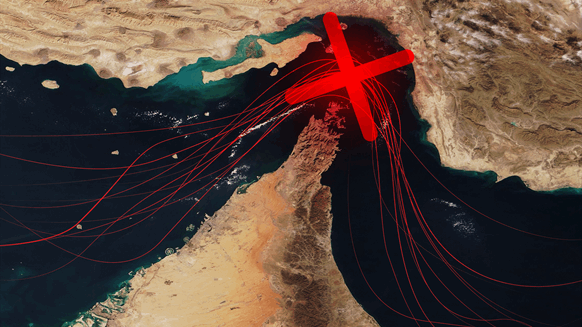
In a market update sent to Rigzone on Wednesday by Rystad Energy, Jorge Leon, Head of Geopolitical Analysis at Rystad, noted that tanker traffic through the Strait of Hormuz had “essentially stopped”.
Leon, who outlined that the development “tells you more about risk perception right now than any statement from Washington or Tehran”, said Brent’s “climb to its highest level since 19 June shows how quickly the market is pricing in a ceasefire the U.S. president himself says is over”.
The Rystad Energy Head went on to state that “the real test comes after 9 July, once the mourning period [for late leader Ayatollah Ali Khamenei] rends and both sides show whether there is still an appetite for a diplomatic off-ramp”.
In the report, Rystad noted that the “Strait of Hormuz ceasefire looks to be over, with reported attacks on commercial vessels triggering a new round of U.S. retaliatory strikes overnight, and President Trump himself declaring the truce ended”.
During his time in Ankara, Türkiye, for the 2026 NATO Summit, .
“To me, I think it’s over,” Trump said at the gathering yesterday, a video posted on Rapid Response 47’s X page, which was reposted by the White House X page, showed.
“I don’t want to deal with them anymore … I’ll speak to our negotiators. They want to negotiate – they’re good people … but they have to come back to me. As far as I’m concerned, it’s just a waste of time dealing with them,” he added.
Rystad said in its update that it’s unclear whether diplomatic channels remain open in practice, adding that the latest military exchanges raise the risk that talks will either stall or continue under much more fragile conditions.
“Fundamentally, the events of the last few days significantly weaken any confidence that the current 60-day truce can still evolve into a permanent peace agreement,” Rystad said in the update.
The update highlighted that oil markets “reacted quickly to the renewed geopolitical risk”, pointing out that Brent rose to near $79 per barrel.
“The move highlights how sensitive prices remain to any escalation around the Strait, given its role as a critical transit route for global oil flows,” Rystad said in the update.
“Even if no sustained physical disruption materializes, uncertainty around vessel safety, insurance costs, potential delays, and the risk of further retaliation is likely to keep volatility elevated in the near term,” it added.
Rystad projected in the update that traffic through the strait “will almost certainly remain reduced until the security situation becomes clearer and market participants gain more visibility on whether a diplomatic off-ramp remains available”.
According to Rystad, vessel movements in the Strait had dropped from around 20 vessels on July 6 to 11 the following day. Tanker traffic at the time of the update’s release appeared to be “completely halted”, Rystad outlined in the update.
“After the burial ceremony of Supreme Leader Ayatollah Ali Khamenei … ends on 9 July, both sides could adopt an even harder stance, driving a further uptick in geopolitical risk premiums,” Rystad warned.
“This would be amplified by the summer peak season for road and aviation fuels, when demand-side sensitivity to supply disruption is already elevated,” it added.
Rigzone contacted the White House and the Iranian Ministry of Foreign Affairs for comment on Rystad’s update.
In response, a White House spokesperson referred Rigzone to Trump’s comments during the NATO Summit on Wednesday. In addition to outlining that he thought the ceasefire with Iran was over, Trump said, “I don’t want to waste my time with them [Iran] … I’ll let our wonderful negotiators keep talking if they want but I don’t see it”, the video on Rapid Response 47’s X post showed.
At the time of writing, the Iranian ministry has not responded to Rigzone. Rigzone has also asked the ministry for comment on Trump’s statements. At the time of writing, the ministry has not responded to this Rigzone request either.
In a statement posted on Saxo Bank’s website on Wednesday, Saxo Bank Head of Commodity Strategy, Ole Hansen, highlighted that Brent crude had jumped more than nine percent since Monday, “rising back towards $79 per barrel as renewed U.S.-Iran tensions revive supply concerns and force a rethink among hedge funds that had recently cut bullish exposure to near-historic lows”.
Hansen outlined in the statement that the oil price move marked a “sharp reversal from last week, when Brent briefly traded near $70 as the market focused on the reopening of regional supply routes and the prospect of a growing surplus of barrels from the Persian Gulf”.
“Before the latest escalation, competition among regional producers to reclaim clients and lost market share had continued to intensify,” he added.
“A small mountain of barrels had been piling up inside the Gulf, increasing the need to move volumes quickly to free storage capacity and allow production to resume or increase,” he continued.
“It increasingly resembled a seasonal sale, with producers cutting prices to clear the shelves and make room for the next collection. Saudi Arabia’s recent price cut sent a clear message of intent: the region was back in a race for market share,” Hansen noted.
Hansen went on to state that this underlying supply challenge has not disappeared but added that the latest escalation has interrupted it.
“The market is again being forced to price the risk that renewed attacks on shipping, or a broader breakdown in U.S.-Iran relations, could slow the normalization of flows through the Strait of Hormuz,” he said.
“As one of the world’s most important energy chokepoints, even limited disruption can have an outsized impact on prompt pricing, freight costs and market sentiment,” he added.
Hansen warned in the statement that positioning may amplify the move.
“In the latest COT reporting week to 30 June, managed money accounts cut their Brent net long by 38 percent to just 55.6k contracts, down around 87 percent from the March peak of 429k,” he pointed out.
“With gross shorts hovering near an all-time high, the long-short ratio had slumped to just 1.2 longs per short, also near a historic low. Such extremes have in the past proved difficult to sustain when the fundamental or geopolitical narrative suddenly changes,” he added.
While Brent was trading near $79 per barrel on Wednesday, Hansen projected that additional short covering could drive further near-term gains, “particularly if security conditions deteriorate or the ceasefire formally collapses”.
“The forward curve is sending a similar signal, with the Brent prompt spread surging back into a backwardation of around 60 cents per barrel from a recent 40-cent contango,” he said.
“For now, this highlights a market once again being driven by supply-risk concerns and position adjustments rather than surplus fears,” he added.
Looking “beyond the immediate geopolitical risk” in his statement, Hansen said China remains a key swing factor.
“Chinese imports fell sharply during the war, and the response from refiners and state buyers to lower prices will help determine whether the Gulf’s accumulated barrels can be absorbed without renewed downward pressure,” he noted.
“China has increasingly acted as a price stabilizer in recent years, buying into storage when prices were low and reducing purchases when prices spiked,” he added.
Looking ahead, Hansen said Beijing “is likely to proceed carefully, seeking to rebuild strategic and commercial inventories without triggering a China-driven price spike”.
“Once the initial Gulf stock clearance has run its course, some moderation in regional competition may emerge, not least to prevent a deeper slump below $70, from where prices could struggle to recover,” he added.
“For now, however, the focus has shifted back to Hormuz, the durability of the ceasefire and the risk that wrong-footed short positioning, combined with thin summer holiday liquidity, could amplify both prices and volatility,” Hansen concluded in the statement.
To contact the author, email