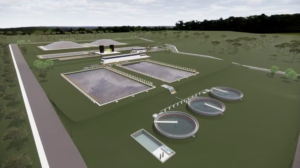
Excavation work began in October last year for the pit for the first of the small modular reactors at the site. About 1.5 million cubic metres of soil were excavated during the digging of a pit 13 metres deep. In March this year, Rosatom said that about 900 cubic metres were being poured during the concrete foundation work for the reactor building. After that was levelled and waterproofed, a ceremony was held in June to mark the pouring of the first concrete for the reactor building’s foundation slab.
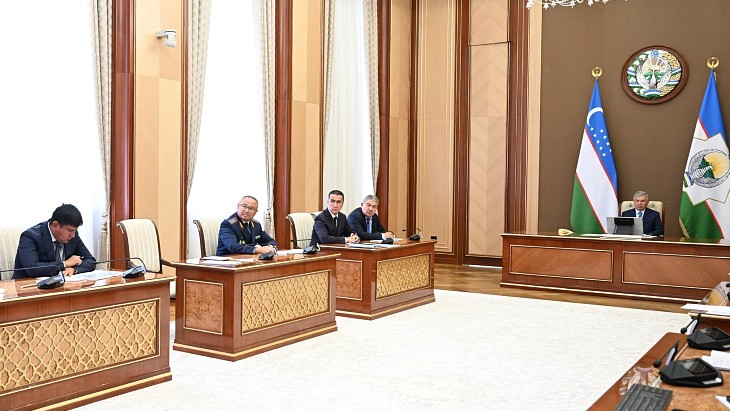
According to a presidential website report on a progress briefing to the president, it says he was told that excavation work has been completed on an area of 100 hectares at the construction and installation base, with 450 workers and specialists, and more than 100 items of specialised equipment, working at the site.
“According to preliminary estimates, local production accounts for 21 percent of the project … the head of state noted that this figure is insufficient. The goal is to increase the share of domestic production in the project to at least 30 percent, ensure that 65 percent of construction and installation work is carried out by national enterprises, and attract 7,000 local workers and specialists,” the report says.
To help this process, the president approved a plan for a 200-hectare industrial zone which would attract tax and customs benefits for firms, which are expected to include “at least 100 joint ventures” and help “localise production in 15 areas through technology transfer”.
For the infrastructure works – which include 39 kilometres of roads, 11 kilometres of railway and 388 kilometres of electrical networks – the president said he wanted to see a 60-70 percent share of local products and services.
There is also a plan for a 200-hectare city for nuclear workers, which will have around 10,000 apartments for about 33,000 residents and include “energy-efficient multi-story buildings, schools and preschools, healthcare, sports, and cultural facilities, recreation areas, and extensive green spaces”.
The presidential office’s report adds: “Taking into account the expansion of the functions of the Uzatom Agency and the Directorate for Nuclear Power Plant Construction, proposals for a phased strengthening of their organisational and personnel potential were considered.
“The head of state gave specific instructions to responsible officials to ensure high quality, safety, and timely construction of the nuclear power plant and the city of nuclear workers, expand the participation of domestic enterprises, and coordinate the implementation of infrastructure projects and personnel training programmes.”
Background
Uzbekistan has a long nuclear-related history with considerable mineral deposits – it is the world’s fifth-ranking uranium supplier. It has also had two research reactors, a 10 MW tank type – WWR-SM – which has been operating since 1959 at the Institute of Nuclear Physics, Uzbek Academy of Sciences near Tashkent, and a small 20 kW one operated by JSC Foton in Tashkent which was decommissioned between 2015-19.
It has had long-term plans to develop nuclear energy capacity and a contract was signed in May 2024, during a visit to the country by Russian President Vladimir Putin. It was originally for the construction of a 330 MW capacity nuclear power plant featuring six units of the RITM-200N water-cooled small modular reactor (SMR), which is adapted from nuclear-powered icebreakers’ technology, with thermal power of 190 MW or 55 MWe and with an intended service life of 60 years. The first unit was scheduled to go critical in late 2029 with units commissioned one by one.
In 2025, a supplemental agreement to the contract for the new nuclear power plant – in the Jizzakh region – covered the decision to change its contents to two gigawatt-scale VVER-1000 units and two SMRs. This increased the proposed capacity to more than 2,100 MWe, compared with the previous 330 MWe. It is the first export order for Russia’s SMR. The first land-based version is currently being built in Yakut, Russia, with the launch of the first unit scheduled for 2027.