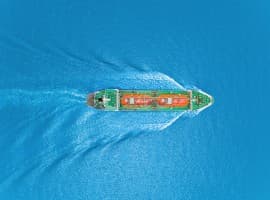
While Iran-linked vessels appear to steer clear of the U.S. blockade outside the Strait of Hormuz, several ships have undertaken lengthy and winding routes in recent hours to move from the UAE coast to the actual Strait close to Iran’s shoreline.
At least two vessels linked to Iran and sanctioned by the United States entered the Persian Gulf on Thursday through a new route, ship-tracking data compiled by Bloomberg showed.
LPG carrier G Summer, broadcasting China owner and crew, has made its way into the Gulf by passing between Iran’s Larak and Qeshm islands. The Hong Lu, another vessel under U.S. sanctions due to ties with Iran, also moved through the same route shortly after, according to the data compiled by Bloomberg. The Hong Lu is a supertanker capable of carrying up to 2 million barrels of crude and was headed into the Persian Gulf empty. The vessel had briefly signaled Iraq’s Basrah as a destination, but now indicates it is waiting for orders.
Ship-tracking has not been a reliable assessment of how and which tankers move around the Strait of Hormuz and the Gulf of Oman, as dark activity and spoofing have flourished since the Iran war began.
“During the first 48 hours of the U.S. blockade on ships entering and exiting Iranian ports, no vessels have made it past U.S. forces,” the U.S. Central Command said on Wednesday.
“Additionally, 9 vessels have complied with direction from U.S. forces to turn around and return toward an Iranian port or coastal area.”
Yet, observed AIS positioning and vessel traffic suggest Iran-linked vessels have been in and out of the Strait of Hormuz, maritime intelligence firm Windward said in its daily note on Wednesday.
“Between April 14 and 15, an empty, falsely flagged, U.S.-sanctioned VLCC was observed entering the Strait inbound via Iranian territorial waters, likely using coastal positioning to reduce exposure, and is similarly assessed as a blockade-breaking movement,” the firm said.
“Iranian export activity continues, supported by loading at Kharg Island and deceptive operational patterns, including spoofing and reduced visibility.”
Concluded Windward, “The operating environment is defined by simultaneous enforcement, evasion, and selective movement, with vessel behavior evolving in real time as the practical limits of the blockade are tested.”
By Tsvetana Paraskova for Oilprice.com
More Top Reads From Oilprice.com
- India’s Cooking Gas Crisis Could Persist for Years
- European Buyers Eye Canadian LNG to Diversify Supply
- Repsol Returns to Venezuela With Ambitious Production Growth Plan