Wednesday, 5 March 2025
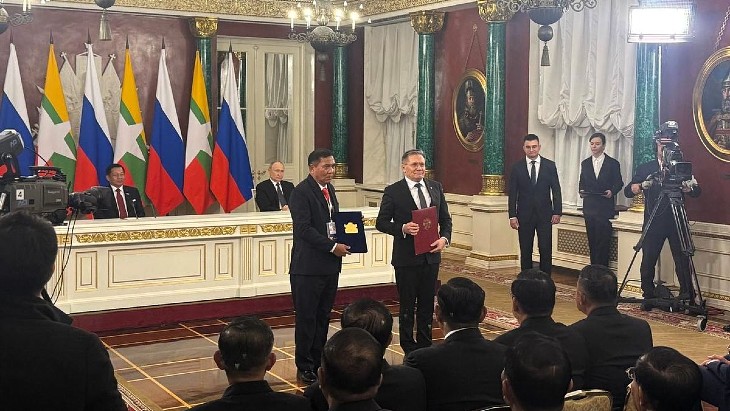
The agreement sets out the terms and main areas of interaction between the parties and the possibility of a further expansion of capacity to 330 MW. It was signed by Rosatom Director General Alexei Likhachev and Myanmar’s Science and Technology Minister Myo Thein Kyaw. A memorandum of cooperation in the field of nuclear and radiation safety was also signed.
Agreements on establishing cooperation between the two countries in the peaceful use of nuclear technology were signed in February 2023, with other agreements also now in place covering workforce training and infrastructure.
Although Myanmar was a founding member of the International Atomic Energy Agency, it does not have any nuclear energy at the moment. It signed a country programme framework with the IAEA in 2016 and also joined the Convention on Nuclear Safety in the same year. It has been a signatory of the Nuclear Non-Proliferation Treaty since 1992. In 2019, Myanmar produced 24.3 TWh of energy with 13.7 TWh from fossil fuels and 10.5 TWh from hydro – Rosatom is also working with Myanmar on a 200 MW wind power plant in the country.
After talks with Myanmar’s Prime Minister Min Aung Hlaing, Russian President Vladimir Putin told reporters the two countries were “exploring opportunities for cooperation in the energy sector … including the use of renewable energy sources” and said the intergovernmental agreement relating to the SMR “paves the way for providing Myanmar’s economy with affordable and environmentally friendly energy. This will serve as a strong impetus for further economic growth, the creation of thousands of new jobs, and the development of highly skilled national personnel”.
Russia already has a land-based SMR under construction and a sea-based one operating and it sees considerable export potential. Last year Uzbekistan signed a contract for a six-unit SMR plant, featuring six of the 55 MW RITM-200N pressurised water reactors adapted from the RITM-200 used in Russia’s nuclear icebreakers.