“Solstice delivered a strong start to 2026, with results ahead of our first-quarter outlook and continued momentum in our highest-growth platforms,” President and CEO David Sewell said. “Demand in Nuclear, Electronic Materials and Refrigerants remains robust, reinforcing our confidence in the secular growth trends driving our business including artificial intelligence, data centres, semiconductor manufacturing and nuclear energy. We are investing behind these opportunities with discipline, while maintaining balance sheet flexibility and returning cash to shareholders through our dividend.”
Nuclear revenues, at USD107 million, were 27% up year-on-year, reflecting both favourable pricing and increased volumes, the company said.
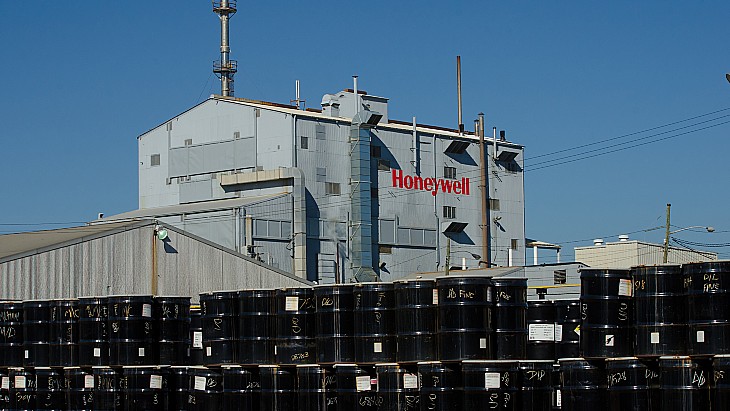
Solstice Advanced Materials was spun off from General Atomics’ former joint venture partner Honeywell last October. Earlier this year, it announced plans to increase output from its Metropolis Works plant in Illinois – the USA’s only domestic uranium conversion facility – and is looking into building a sister plant to the existing facility, which was built in the 1950s and began providing uranium hexafluoride (UF6) for civilian use in the late 1960s.
Halo agreement
On 30 April, micro-modular reactor (MMR) developer Hadron Energy, Inc announced it had signed a Uranium Conversion Services Agreement with ConverDyn which it said would directly enable the first deployment of the company’s Halo MMR and its scalable commercial rollout. ConverDyn, a partnership between Solstice and General Atomics, is the exclusive marketing agent for all UF6 produced at Metropolis.
Under the agreement, ConverDyn will supply UF6 supporting Hadron’s fuel fabrication pathway beginning with the first-of-a-kind deployment of the Halo MMR, which is based on light water reactor technology and would generate 10 MWe and 35 MW of thermal heat. The agreement has the potential to expand across subsequent commercial units as Hadron scales toward repeatable delivery, in a collaboration spanning the full commercialisation of the Halo reactor.
“Fuel is not a procurement afterthought; it has to be a foundational consideration from day one. Conversion is the critical first step that transforms uranium into a form that can be enriched and fabricated into reactor fuel. ConverDyn provides the only commercial UF6 produced in the United States, and securing this relationship now means our fuel supply pathway is grounded in domestic infrastructure, regulatory familiarity, and operational credibility. That is exactly the kind of supply chain foundation a programme like ours needs to move from design and licensing to a fuelled, operating reactor,” Hadron Energy Chief Nuclear Officer Ross Ridenoure said.
Hadron has recently signed a non-binding Memorandum of Understanding with Smartland Energy, LLC, a developer of modular, behind-the-meter power infrastructure for large industrial and digital loads, to collaborate on evaluating the potential deployment of the Halo MMR technology across up to five qualified Smartland projects. It has also signed an MoU with Paragon Energy Solutions, a Mirion Technologies Company, to develop the instrumentation and control architecture for the Halo MMR.
The US Nuclear Regulatory Commission has accepted for review the company’s Quality Assurance Program Description Topical Report – described by Hadron as an “an early but foundational step in the licensing process that establishes the quality framework governing all of Hadron’s nuclear design, procurement, and construction activities”. Hadron has also recently submitted its Principal Design Criteria White Paper to the US regulator as part of the formal pre-application engagement process.