Wednesday, 11 December 2024
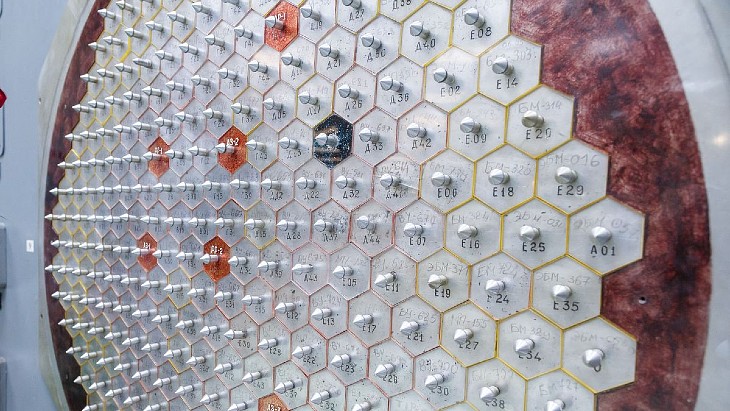
The irradiation is taking place in the MIR.M1 research reactor at the Dimitrovgrad Research Institute of Nuclear Reactors and is seen as being the first step in the gradual validation of nuclear fuel with enrichment above 5% – the existing figure is typically between 3% and 4.95%.
Rosatom says it will enable the extension of the current 12-18 month fuel campaigns, to 24 months – cutting the length of time units need to be shut down for refuelling. Reducing the number of fresh fuel bundles in a reload batch would also have a positive economic impact, the company says.
The trial will take the form of four one-year irradiation cycles at MIR.M1, a research reactor which has been in operation since 1967, it is a channel-type reactor with a beryllium moderator and reflector and it has loop facilities with different coolants. Rosatom’s fuel arm, TVEL, manufactured 12 VVER-1000 sized fuel elements with uranium-erbium matrix – the first time this mix of VVER fuel has been loaded in a reactor, and was able to build on its experience of fabricating uranium-erbium fuel for RBMK-type reactors.
According to Rosatom, “erbium is better suited as a neutron absorber for operation of fuel with enrichment above 5% in fuel cycles longer than 18 months in comparison with gadolinium, which is used a regular absorber for VVER reactors (the absorber is added to nuclear fuel to compensate for reactivity in the reactor core)”.
Alexander Ugryumov, vice president for research and development at TVEL, said: “Increasing uranium enrichment to 6%, and in the long term to 7-8%, is a global trend and a task that industry leaders are working on. So far, reactor efficiency has been improved by introducing new designs and modifications of fuel assemblies. Basically, most of these innovations have been aimed at increasing the physical volume of enriched uranium in a fuel element and ultimately produce more energy from a single fuel bundle. The industry has now reached a fork in the road where further enhancing of NPPs’ performance probably requires crossing the 5% enrichment threshold for high-capacity thermal reactors. Considering that there are 163 fuel assemblies in the core of the modern VVER reactors, and each of them contains more than 500kg of uranium, the impact from increasing enrichment by just 1% will already be very significant.”
The results of the trial will be used as part of the development of uranium-erbium fuel for VVER reactors as well as validation of such fuel for Russian-designed nuclear power plants.