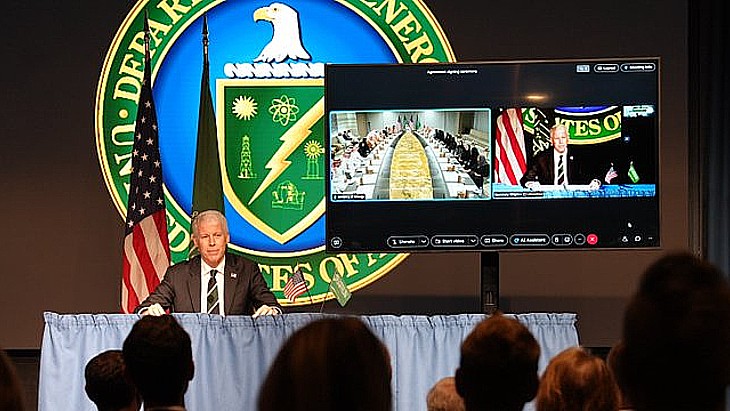
The agreement “aims to enhance cooperation between the two countries in the peaceful uses of nuclear energy and to facilitate the exchange of expertise, knowledge, and technologies, contributing to strengthening bilateral cooperation in accordance with the highest international standards of nuclear safety, nuclear security, and nonproliferation”, according to a statement published by Saudi Arabia’s official national news agency, SPA. It also “reflects the shared vision of both countries to expand cooperation in energy and future technologies while supporting sustainable development”.
Formal cooperation agreements are required between countries that want to trade nuclear power goods and services. Those involving the USA are known as 123 Agreements after the paragraph of the country’s 1954 Atomic Energy Act which requires them.
No details have been given about the contents of the agreements, although media reports ahead of the announcement by the two countries suggested that the agreement was expected to include provisions that would allow Saudi Arabia to enrich uranium. However, this is seen as a potential nuclear proliferation risk: the same technology used to increase the content of the fissile uranium-235 isotope to levels needed in nuclear fuel (typically up to 5% for nuclear reactors in operation around the world today) could also be used to produce weapons-usable highly enriched uranium. Previous 123 Agreements concluded by the USA with other countries – including that concluded with the UAE in 2009 – have specifically prohibited those countries from developing domestic uranium enrichment capabilities.
The US Department of Energy (DOE) said the two agreements “lay the legal foundation for a decades-long, multi-billion-dollar partnership that advances several priority economic and strategic objectives, including nuclear non-proliferation”, providing “great access for American companies in the Saudi nuclear energy programme” as well as advancing US and regional security by “upholding high standards of nuclear safety, security, and non-proliferation and strengthening the United States’ competitive edge in civil nuclear technology”.
“These agreements reflect our two nations’ shared commitment to strengthening US-Saudi commercial relations, delivering prosperity at home and security to our allies abroad,” Wright said. “Rest assured, these agreements uphold the highest standards of nuclear safety and non-proliferation, while relying on the world’s best nuclear technology and scientists, designed right here in the United States.”
Saudi Arabia’s electricity generation is dominated by fossil fuels, but the potential use of nuclear power – including for desalination of water – has featured in the country’s plans for many years. It has, over the past decade or so, signed nuclear cooperation agreements with countries including France, Argentina, South Korea, China, Hungary and Jordan, as well as Russian nuclear company Rosatom. According to the , the King Abdullah City for Atomic and Renewable Energy (KA-CARE) – set up by the Saudi government to advance its nuclear and renewable energy agenda – has also been in negotiations with the Czech Republic and the UK as well as the USA.
The 123 Agreement is to be reviewed by the US Congress.