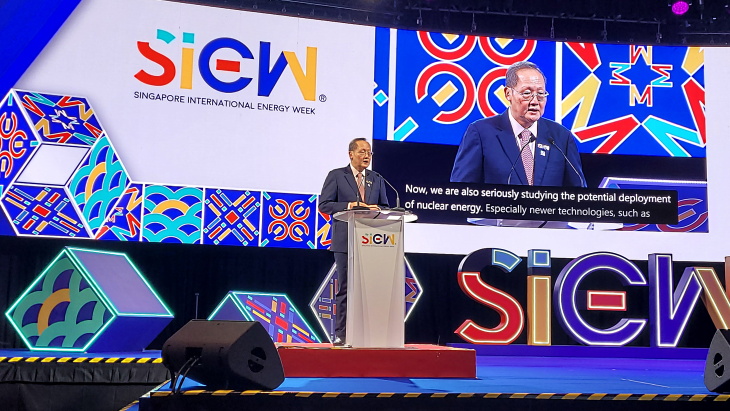
“Rising geopolitical uncertainties have led to countries reassessing their climate ambitions, placing renewed emphasis on economic resilience and self-sufficiency, at the expense of decarbonisation efforts,” Tan said. “Yet, nature will wait for no man. Climate change continues to accelerate, and its impact will profoundly affect how we live, work, and thrive. For Singapore – a small low-lying island and an alternative-energy disadvantaged city-state – these challenges are far more acute. To secure a low-carbon energy future for generations to come, we must plan smarter and work harder.”
He said Singapore “must pursue a diversified portfolio of sustainable energy pathways to build the future we envision. It is unlikely that any single solution will suffice, just as there is no one-size-fits-all solution to decarbonisation.”
Tan said nuclear energy has the potential to be “a safe, reliable, and cost-competitive option for Singapore”. He noted that Prime Minister Lawrence Wong announced earlier this year that the government would reorganise itself to place greater emphasis on capability building.
“We have since formed dedicated nuclear energy teams within key agencies to lead these efforts – namely, the Nuclear Energy Office within the Energy Market Authority (EMA) and the Nuclear Safety Division within the National Environment Agency (NEA). These teams will focus solely on nuclear energy issues, and I hear they are hiring actively.” Tan said Singapore is “also actively collaborating with international partners”.
“We understand that the public has many queries about our plans,” he said. “We will engage the public regularly as we progress on this journey together. For a start, we are releasing a today to provide an overview of our interests, and the government’s work on capability building thus far.”
The 16-page background paper outlines Singapore’s approach to studying the potential for domestic nuclear energy deployment. It explains the factors to consider in this endeavour, including the safety, reliability, affordability, and environmental sustainability of nuclear technology in Singapore’s context. The paper has been produced by the Ministry of Trade and Industry, the Ministry of Sustainability and the Environment, EMA and NEA.
The paper stresses that Singapore has not made any decision on the deployment of nuclear energy. “We will continue our efforts to build up domestic capabilities, supported by international partners. We will engage the public regularly on the latest developments in nuclear energy, to build an informed understanding of the benefits and risks surrounding nuclear energy,” it says.
In 2012, the Singapore government conducted a pre-feasibility study on nuclear energy. While the study concluded that nuclear power plants of the time were not suited for a small and densely populated city-state, it recommended that Singapore continue to monitor the progress of new nuclear energy technologies.
In March 2022, EMA released a report that concluded nuclear energy could supply around 10% of Singapore’s energy needs, helping its power sector achieve net-zero carbon emissions by 2050.
In October 2024, EMA signed a memorandum of understanding with the UAE’s Emirates Nuclear Energy Company to develop capabilities in nuclear energy. Through the MoU, both parties will work together to strengthen capabilities in nuclear science and technology, and identify activities of mutual interest in areas such as the assessment of emerging nuclear technologies and human resource development. The parties will facilitate information sharing through workshops, technical exchanges, and/or staff attachments.
Delivering his Budget 2025 speech in February this year, Wong – who is also Finance Minister – said the government will study the potential deployment of nuclear power in Singapore and take further steps to systematically build up capabilities in this area. “We will need new capabilities to evaluate options, and to consider if there is a solution that Singapore can deploy in a safe and cost-effective way,” he said.
In September, the Energy Market Authority appointed UK-headquartered engineering firm Mott MacDonald to conduct a study on the safety and technical feasibility of advanced nuclear energy technologies. The study will evaluate the safety performance and technical feasibility of advanced nuclear energy technologies, such as small modular reactors, based on their safety features, technology maturity, and commercial readiness.