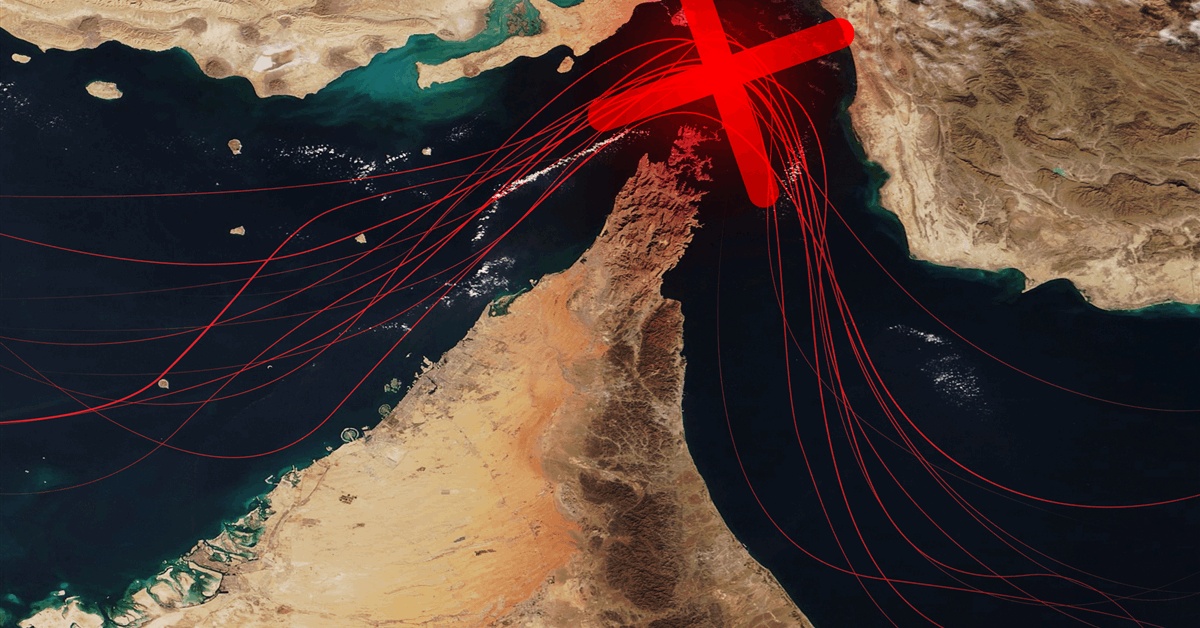
The Strait of Hormuz (SoH) is now essentially fully closed, Skandinaviska Enskilda Banken AB (SEB) Chief Commodities Analyst Bjarne Schieldrop stated in a SEB report sent to Rigzone on Tuesday.
“Iran won’t allow non-Iranian oil out while the U.S. blockade will prevent Iranian oil to transit out through the SoH,” Schieldrop highlighted in the report.
“The only oil coming from the Middle East is now coming from Saudi Arabia through the East-West pipeline to Yanbu in the Red Sea. From normal exports of around 1.5 million barrels per day to now maybe an average of around 5.5 million barrels per day,” he added.
Schieldrop warned in the report that the market is now increasingly starved for oil.
“Close to all oil from the Persian Gulf on water before the war broke out on 28 Feb has now likely been delivered with only some Iranian oil on water out of SoH since then,” he pointed out.
“Every day the SoH now is closed the physical supply situation should get worse – increasing heat and prices in the physical market for crude and products,” he said.
Schieldrop outlined in the report that if the Strait is not opened before the beginning of May, the Brent financial contract “will likely have to follow spot prices higher”.
“It is clear that if the war is not resolved and the SoH is not reopened by end of April, then the crude and product spot prices will move yet higher with Dated Brent heading to $150 per barrel, and higher, while the financial Brent contract (now June) will eventually have to follow suit,” he added.
In the report, Schieldrop highlighted that the Brent June contract was trading at under $100 per barrel on Tuesday. He pointed out that this contract traded at a high of $103.87 per barrel on Monday “following the breakdown in U.S.-Iran talks and the announcement of the U.S. blockade of the SoH”.
“Concerns eased a bit through the day with the contract closing at $99.36 per barrel,” Schieldrop noted.
“This morning the contract is down 0.8 percent to $98.6 per barrel on hopes and signals that the two parts will revive talks,” he said.
Schieldrop went on to warn in the report that “what really stands out in the market today is the massive difference between nearer term spot prices versus the deferred financial Brent June contract”.
“The Dated Brent spot price yesterday closed at $132.5 per barrel while it last week traded to a high of $144.5 per barrel on 7 April,” he stated.
“The Brent financial contract and the Dated Brent spot price usually follow each other very tightly. Now there is a huge difference with Dated Brent at $132.5 per barrel versus the Brent June contract at only $98.9 per barrel,” he added.
“The first is showing how tight the physical market is today due to the closer of the SoH. The much lower June contract is showing that the market is close to dead certain that the issue of the closure of the SoH will be solved in good time before June,” he went on to state.
“In our view the June price at $98.9 per barrel is basically indicating that the SoH will fully reopen by 1 May,” he continued.
Rigzone has contacted the White House and the Iranian Ministry of Foreign Affairs for comment on Schieldrop’s statement. At the time of writing, neither have responded to Rigzone.
In an oil flash note sent to Rigzone by Natasha Kaneva, J.P. Morgan’s head of global commodities strategy, on Sunday, analysts at J.P. Morgan, including Kaneva, highlighted that, “historically, the spread between Dated Brent and front-month ICE Brent futures contract is modest, typically $1-2 per barrel, reflecting a smooth-functioning arbitrage between physical and paper markets”.
The analysts went on to warn that “today’s much wider gap signals a market struggling to source barrels for delivery now, even if it still assumes supply will normalize later”.
“In that sense, the strength in Dated Brent is the market’s way of signaling that time has become a scarce commodity,” the analysts added.
In a statement sent to Rigzone on Monday, Naeem Aslam CIO at Zaye Capital Markets, noted that global equities were opening “under decisive pressure as a sudden escalation in Middle East tensions – centered on a U.S. naval blockade of the Strait of Hormuz … triggered a sharp risk-off shift across markets”.
“The immediate surge in oil prices above $100 is forcing a rapid repricing of inflation expectations, monetary policy paths, and corporate earnings outlooks, particularly for energy-sensitive economies in Europe,” he added.
“With roughly one-fifth of global oil flows at risk, markets are now transitioning into a headline-driven regime where geopolitical developments, rather than fundamentals, are dictating price action – leaving equities vulnerable to further downside as volatility resets higher,” he warned.
In a statement posted on U.S. President Donald Trump’s Truth Social page on April 12, Trump outlined that a meeting with Iran “went well”, adding that “most points were agreed to”, but said “the only point that really mattered, NUCLEAR, was not”.
“Effective immediately, the United States Navy, the Finest in the World, will begin the process of BLOCKADING any and all Ships trying to enter, or leave, the Strait of Hormuz,” he announced in that statement.
“At some point, we will reach an “ALL BEING ALLOWED TO GO IN, ALL BEING ALLOWED TO GO OUT” basis, but Iran has not allowed that to happen by merely saying, ‘There may be a mine out there somewhere,’ that nobody knows about but them,” he said.
“THIS IS WORLD EXTORTION, and Leaders of Countries, especially the United States of America, will never be extorted. I have also instructed our Navy to seek and interdict every vessel in International Waters that has paid a toll to Iran. No one who pays an illegal toll will have safe passage on the high seas. We will also begin destroying the mines the Iranians laid in the Straits,” he noted.
“Any Iranian who fires at us, or at peaceful vessels, will be BLOWN TO HELL!,” he warned.
In a follow up statement posted on his Truth Social page on April 13, Trump said the U.S. would “Blockade Ships Entering or Exiting Iranian Ports on April 13 at 10:00 A.M. ET”.
A statement posted on the X page of Seyed Abbas Araghchi – the Foreign Minister of the Islamic Republic of Iran – on April 12, said, “in intensive talks at highest level in 47 years, Iran engaged with U.S in good faith to end war”.
“But when just inches away from ‘Islamabad MoU’, we encountered maximalism, shifting goalposts, and blockade. Zero lessons earned. Good will begets good will. Enmity begets enmity,” he added in that statement.
To contact the author, email