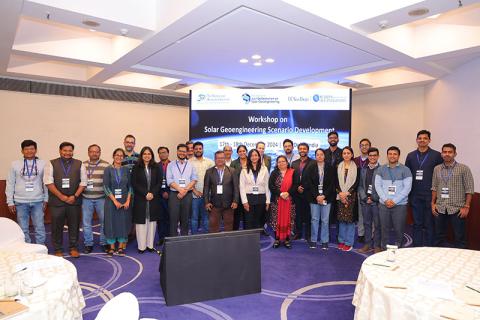
The Energy and Resources Institute (TERI) in collaboration with the Alliance for Just Deliberation on Solar Geoengineering (DSG), and the School of Global Policy and Strategy at the University of California and Scripps Institute of Oceanography organized a workshop focusing on SRM Geoengineering Scenarios. About 30 researchers from the fields of meteorology, environmental science, climate modelling, atmospheric chemistry, engineering, economics, and governance explored the status of research relating to Solar Radiation Management (SRM) technologies.
Experts call for enhanced research and inclusive governance to address SRM’s uncertainties and geopolitical impacts
SRM technologies are being considered as a temporary emergency measure to combat global warming if efforts to reduce greenhouse gas emissions fall short of the Paris Agreement’s goal to limit warming to 1.5°C. SRM is an intervention in the atmospheric concentration of aerosols that reflect the sunlight back and hence reduce the amount of heat entering into earth’s atmosphere creating a cooling effect.
The workshop included technical presentations, interactive discussions, and deliberations on research gaps in the context of informed decision-making on SRM research and deployment. Experts from IISc (Bangalore), IITM (Pune), CSTEP (Bangalore), TERI (New Delhi), UCSD (USA), and DSG (USA) provided an overview of the science of SRM and its integration into earth system models, climate policy and governance issues related to SRM research and deployment, impacts of climate change and SRM deployment scenarios. In the subsequent breakout sessions, participants deliberated on various uncertainties related to scientific knowledge as well as policy and governance possibilities that need to be answered before any conclusive decision on SRM research and governance can be taken at the national and global level.
Introducing the workshop, Ms Suruchi Bhadwal, Director of the Climate and Air Programme at TERI noted, “The issue of SRM has drawn sharp and opposing reactions from the scientific and civil society communities. However, it is critical for rational and informed thinking that all aspects of the issues are thoroughly explored.” Dr Shuchi Talati of DSG observed, “A robust and inclusive engagement on scientific understanding of SRM research and governance is important. At present, the discussions are centred predominantly in the Global North, whereas in Global South there is a serious lack of awareness, with few exceptions.” Speaking on the occasion, Dr Anita Gupta, Climate, Energy and Sustainable Technology (CEST) Division, Department of Science and Technology, said, “India’s climate policy follows a robust integrated scientific approach through multiple missions as part of the National Action Plan on Climate Change. Enhanced scientific understanding is necessary for robust strategic policy choices.”
The workshop concluded with the observation that more scientific research is needed to understand the impact of SRM deployment on various ecosystems and sectors like energy, agriculture, water, Indian monsoon, Himalayan ecosystem along the distributional dimensions of time, community, and geographies. Accordingly, governance deliberations need to engage with distributional issues like transparency, accountability, liability, justice, economic opportunities and the geopolitical implications of the impacts of SRM. Furthermore, the participants also emphasized that robustness and accuracy of scientific models for meaningful simulations and adequate observational data to verify and understand the regional and global impacts of SRM deployment scenarios is critical.
The participants included researchers at Aurassure (Bhubaneshwar), University of Kashmir, Jawaharlal Nehru University, Delhi Skill and Entrepreneurship University, University of Kochi, CSIR-North East Institute of Science and Technology, IIT Roorkee, India Meteorological Department, RIMES-Delhi, Hero Future Energies, TERI School of Advanced Studies, and MAHE – Manipal Academy of Higher Education in their independent capacity.
The workshop underscored the need for interdisciplinary collaboration and global inclusivity to address knowledge gaps, ensuring informed decision-making on SRM. Participants advocated for advancing research and governance to assess SRM’s potential impacts and challenges comprehensively.