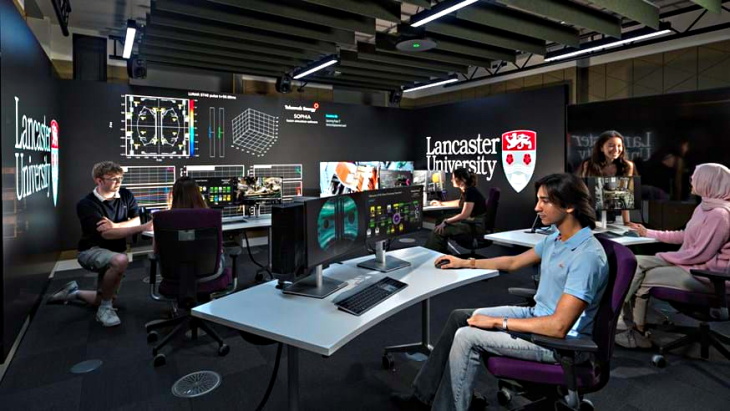
The university said the simulator was the first of its kind in the UK and would support the country’s clean energy goals and help enhance future nuclear safety.
Funded through a GBP2 million (USD2.7 million) grant from the Office for Students, the Lancaster University Nuclear Operations Simulator includes a wraparound screen across three sides of the new facility, which, along with software similar to that found across a range of nuclear reactors, provides an immersive experience for students. It includes what is described as a highly reconfigurable design and software for different reactor types including pressurised water reactors, small modular reactors, and tokamak fusion reactors, with software codes developed by GSE Solutions, Westinghouse, Norway’s Institute for Energy Technology, and Tokamak Energy.
Tokamak Energy said it has installed its SOPHIA software programme into the simulator, which was originally developed to predict, simulate and validate experiments in the company’s record-breaking ST40 fusion machine. It said the software allows scientists and engineers to get maximum gains from every experiment without needing to test multiple scenarios in the physical machine – which reaches plasma temperatures six times hotter than the centre of the sun – removing human error and fast-tracking results.
“This is a fantastic initiative by Lancaster University that we are extremely proud to support,” said Ross Morgan, Tokamak Energy’s Fusion Managing Director. “Young people are more aware than ever that the world needs a new supply of clean, secure energy. We hope our tokamak simulator SOPHIA will inspire students to pursue a career in fusion energy and help make the world a better place for future generations.”
The simulator also includes leading-edge audio-visual equipment that can be used to flexibly configure different scenarios and record student interactions in the simulation environment to support student feedback. It has also been designed so that furniture can be reconfigured to represent different control room layouts.
The facility will be ready for teaching students at the university from the next academic year.
Lancaster University currently hosts the only single honours Nuclear Engineering undergraduate programme in the UK and has one of the country’s strongest nuclear science and technology research communities with expertise across the fission and fusion fuel cycles, nuclear medicine, nuclear security and safeguards.
Rebecca Lingwood, Deputy Vice-Chancellor at Lancaster University, said: “This fabulous new facility will augment Lancaster’s long-established strength across disciplines such as nuclear engineering and cyber security, providing our students with a truly excellent learning experience. Lancaster University plays a vital role as an economic anchor institution in north-west England and this facility will further enable us in helping to deliver a new generation of young people equipped with the skills needed to support a low-carbon energy sector vital for national energy security, as well as a critical sector for the region’s economy.”
Paul Smith, Chair in Networking and Principal Investigator of the initiative, said: “This high-fidelity simulator will enable us to create simulations of scenarios where nuclear facilities are cyber attacked, providing valuable in-depth learning experiences for our cyber security students, some of which may become future cyber security professionals protecting our critical national infrastructure.”
Samuel Murphy, Director of Studies for Nuclear Engineering at Lancaster University, added: “This exciting and deeply immersive new facility will greatly enhance the experience and learning opportunities for students on our Nuclear Engineering programmes, helping to maintain Lancaster’s position as a leading provider of nuclear education in the UK.”