When will global gas demand peak?
According to a statement sent to Rigzone by the GlobalData team this week, the answer to that question is – not before 2035.
“Global natural gas demand will keep growing through 2035 in every scenario, rising by almost a fifth as power generation absorbs half of the increase,” market intelligence platform GlobalData said in the statement.
“The LNG glut the market expected for 2026 will arrive later and end sooner, and the binding constraint on supply over the next decade will be export infrastructure rather than reserves,” GlobalData added in the statement, which highlighted a newly released gas market outlook report from the company.
The statement outlined that this report sees world gas demand rising just under 20 percent between 2025 and 2035, to 5,180 bcm, at a compound annual growth rate (CAGR) of 1.8 percent.
“Power generation contributes 432 bcm of the increase and Asia-Pacific 284 bcm,” the statement noted.
“The report combines country-level demand modeling, built on detailed macroeconomic, power, and industrial data, with GlobalData’s proprietary asset-level data on gas fields, LNG plants, pipelines, and storage sites, and tests the results across six scenarios,” it pointed out.
2026, 2027, 2030s
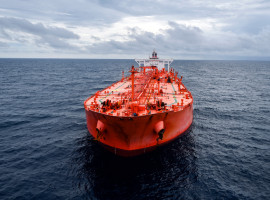
GlobalData’s statement highlighted that the 2026 disruption in the Strait of Hormuz cut off access to about a fifth of global LNG supply and damaged 12.8 million tons per annum of Qatari liquefaction capacity.
“GlobalData estimates that Middle Eastern gas production falls by 98 bcm this year, so world supply grows by only 14.9 bcm against 37.7 bcm of notional demand growth, with an estimated 38-59 bcm of supply-constrained demand unserved,” the company noted.
“From 2027, Gulf exports return and 281.3 mtpa of liquefaction at construction or commissioning stage starts up by 2031, mostly in the U.S. and Qatar,” it added.
The surplus of supply over demand peaks at about 200 bcm in 2029, according to GlobalData. The company added, however, that growing demand “closes it quickly”.
“The market balances in 2034 and turns short in 2035,” GlobalData projected.
“Field by field, 166 bcm of the upstream supply planned for 2035 has no sanctioned or FID-dated route to market, with Senegal, Tanzania, Mauritania, Guyana, and Cyprus accounting for most of it,” it said.
GlobalData went on to note in its statement that the decisive variable for supplying the 2030s is infrastructure.
“Unless export routes are sanctioned in the new frontier, and U.S. production keeps pace with U.S. liquefaction, a market that looks oversupplied today will be short by the middle of the next decade,” it warned.
Glut is Real but Short
GlobalData Oil and Gas Lead Analyst Paul Hasselbrinck noted in GlobalData’s statement that “the market has spent two years debating a gas glut”.
“GlobalData’s field by field data show that the glut is real but short, and that the question for the 2030s is not whether there is enough gas in the ground, but whether the pipelines and LNG plants get built where that gas is,” he added.
Hasselbrinck highlighted in the statement that “2026 was a transit shock, not a resource shortage”.
“Prices in Europe and Asia react to market dislocation, with a main shipping route closed and a small share of liquefaction damaged, but global production rose in 2026,” he said.
“That is why GlobalData expects the market to normalize as Gulf exports return, rather than to reset at a permanently higher level, albeit in a U-shaped, not V-shaped recovery,” he added.
Hasselbrinck went on to state that, “for demand, the risks to the Reference demand outlook are asymmetric and skewed to the downside”.
“The upside from cheaper LNG or an AI-driven power boom is bounded at a combined 3.5 percent of 2035 demand, about a quarter of the eight percent downside from accelerated transition,” he noted.
Global LNG Sector
In a BMI report sent to Rigzone by the Fitch Group earlier this month, analysts at BMI, a unit of Fitch Solutions, outlined that the global LNG market entered the second half of the year “caught between an acute near-term supply shock and upcoming new capacity”.
“The U.S.-Iran conflict and the disruption to shipping through the Strait of Hormuz have removed the bulk of Qatari and Emirati cargoes from the market since March 2026, driving prices sharply higher and forcing importers to rework their sourcing,” the analysts said in the report.
“Europe has weathered the shock by leaning on U.S. and, temporarily, Russian volumes, while holding to its diversification agenda,” they added.
“The U.S. is cementing its role as the market’s swing supplier ahead of a record slate of liquefaction startups,” they continued.
Looking “beyond the conflict” in the report, the analysts said the balance of risk “shifts decisively towards oversupply”, noting that over 200 mtpa of new capacity is set to arrive over the next five years.
“Asian demand led by Mainland China and India gradually absorbs the surplus,” the analysts projected.
In the report, the BMI analysts revealed that they forecast total APAC LNG imports to rise by around 45 percent from 171 bcm in 2026 to 248 bcm by 2035, “as economic expansion, coal-to-gas switching, and a persistent shortfall of regional production relative to consumption drive demand”.
The analysts outlined, however, that the near term remains “volatile”.
“After peaking at 200 bcm in 2024, imports fell 10.1 percent to 180.0 bcm in 2025 and a further 7.4 percent to 171.0 bcm in 2026, as elevated prices linked to the Middle East crisis prompted demand rationing among price-sensitive buyers,” they said.
“As prices ease and new supply arrives, growth in demand will resume, running at 5.5 percent a year from 2028,” they projected.
“China and India together account for more than half of incremental regional import growth, with LNG demand in both markets more than doubling by 2035, as they increasingly rely on imported gas to clear their balances,” they added.
“This demand recovery is the essential counterweight to the liquefaction glut, gradually reabsorbing the surplus and, by the early 2030s, tipping the global market back towards balance,” the BMI analysts went on to state.
To contact the author, email