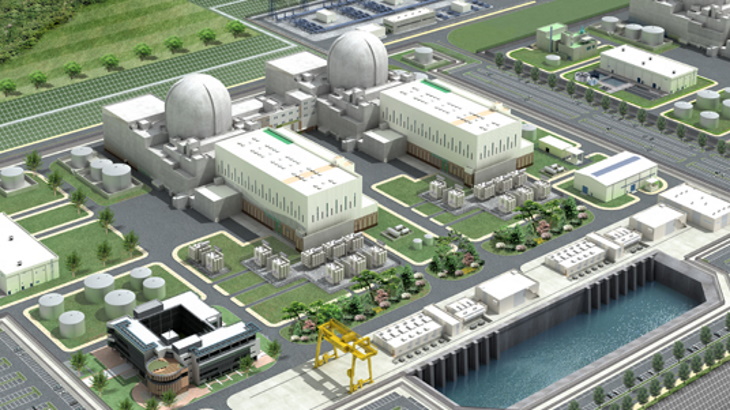
The Basic Power Supply and Demand Plan contains domestic power generation facility plans for the next 15 years. It is updated by the Ministry of Trade, Industry and Energy every two years. A draft of the 11th Basic Plan – which includes plans from 2024 to 2038 – was released in May 2024 and presented to a plenary session of the National Assembly by the Ministry of Trade, Industry and Energy on 19 February last year. It was approved by the National Assembly’s Power Policy Review Committee on 21 February 2025. The plan calls for two new large nuclear power reactors with a combined capacity of 2.8 GWe and 700 MW of small modular reactor capacity to be built by 2038 – in addition to the large reactors already under construction or planned.
During a press briefing on Monday about the forthcoming 12th Basic Plan for electricity supply and demand, which outlines the country’s power supply plan for 2026-2040, Minister Kim confirmed that the construction of two large reactors will proceed as planned under the 11th Basic Plan.
“Prior to this, the Ministry of Climate Change explained that it had conducted two policy discussions (on 30 December 2025 and 7 January 2026) and a public opinion poll (12-16 January) conducted by two organisations regarding the new nuclear power plant construction plan of the 11th Electricity Framework,” the ministry said. “The poll results showed that renewable energy and nuclear power were the most important energy sources for future expansion, in that order. Over 80% of respondents believed that nuclear power was necessary, and over 60% of respondents supported the new nuclear power plant plan reflected in the 11th Electricity Framework.”
Kim said: “To address climate change, carbon emissions must be reduced across all sectors. In particular, reducing carbon emissions in the electricity sector requires reducing coal and LNG power generation. Therefore, power management centred on renewable energy and nuclear power is essential.”
The Ministry of Climate Change said it plans to pursue measures such as “complementing the intermittency of renewable energy through ESS and pumped storage power generation, and complementing the rigidity of nuclear power plants through flexible operation”.
According to the latest plan, South Korea’s demand for electricity will increase by an annual average 1.8% between 2024 and 2038, to reach 129.3 GW by 2038 – an increase of more than 30% from 2023.
Under the 11th Basic Plan, the portion of carbon-free energy sources in South Korea’s energy mix will increase from about 40% in 2023 to 70% by 2038. It says nuclear power generation is expected to grow from 180.5 TWh in 2023 to 248.3 TWh in 2038. The portion of nuclear power generation will grow from 30.7% in 2023 to 35.2% in 2038. The country’s 26 reactors currently provide about one-third of its electricity.
Under the current plan, Korea Hydro & Nuclear Power (KHNP) will launch a bidding process to select the host cities or towns for the two new reactors by 2027. This will be followed by a site evaluation and selection process lasting about five to six months, with the goal of obtaining a construction permit in the early 1930s and completion of the reactors in 1937 or 1938.
Kim said the upcoming 12th power supply plan will include the country’s response to rising electricity demand sparked by the growth of the artificial intelligence (AI) sector and expansion of electric vehicles, Yonhap reported. It will also include an energy mix policy aimed at helping the country achieve carbon neutrality by 2050, he added.